
 By
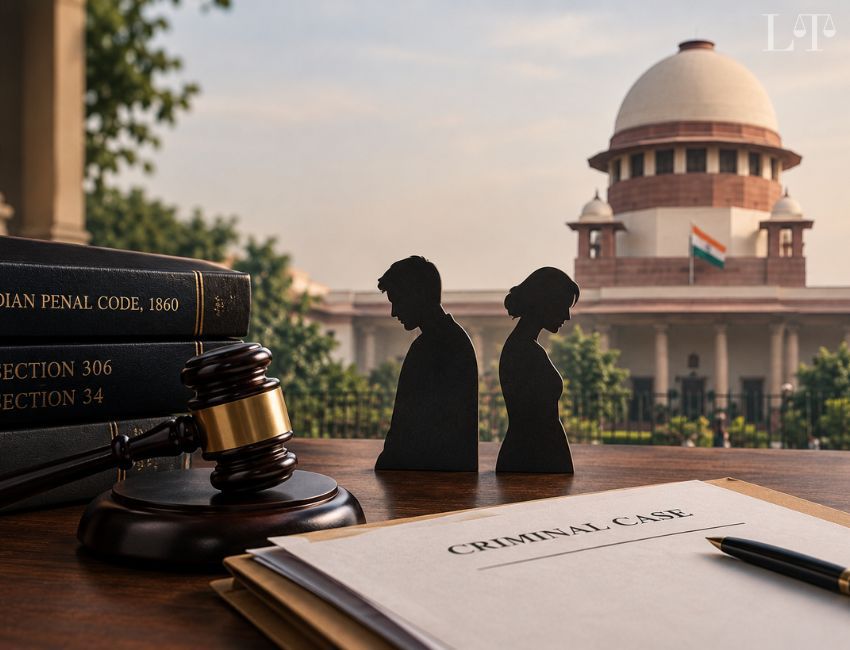
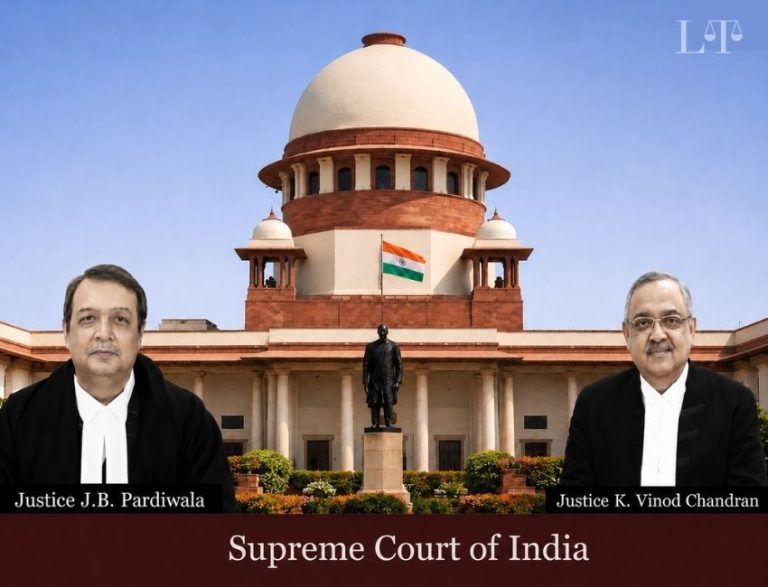
The Supreme Court, comprising Justice J.B. Pardiwala and Justice K. Vinod Chandran, has quashed the criminal case against six people accused of abetment of suicide under Section 306 read with Section 34 of the Indian Penal Code (IPC), 1860.
The Court held that refusing to marry someone cannot automatically be called abetment of suicide just because the woman later died by suicide. The Bench said that if a couple breaks up and one person dies by suicide, this alone does not prove that the other person pushed them to do it. The Court said that the key elements of abetment must be proved first. Only then can a criminal case go on.
Background of the Case:
The case began with the death by suicide of a woman who was in a relationship, by mutual consent, with the first accused. They were not married, but they had been living together at his home for about three months. His family was also said to have accepted the relationship.
The criminal complaint came from a First Information Statement (FIS) given by the woman’s sister. She said she called a friend of the woman after her sister stopped answering phone calls. The friend told her that the woman was living with the first accused. After this, the informant’s elder sister went to his home and brought the woman back to their family home.
The Supreme Court noted that the relationship was by consent and that the couple had lived together for three months. It observed, “In that circumstance it is difficult to comprehend as to why the 1st informant and her sister took the deceased away from the 1st appellant’s house.”
According to the prosecution, the woman went to work the next morning. In the evening, the first accused called the informant and asked where he should drop the woman. The informant asked him to bring her back to their house, but the woman did not return. It was then alleged that the woman phoned her eldest sister and said that the first accused had refused to marry her and that she was ending her life.
Allegations Against the Six Accused
The prosecution said the first accused decided not to marry the woman because the other accused people influenced him. The second and sixth accused were his father and mother. The third accused was his sister. The fourth accused was his friend, and the fifth accused was the man his sister was going to marry.
The allegations were that the fourth accused spoke badly about the woman to the first accused, which made him back out of the marriage proposal. The third accused also allegedly pushed the first accused to end the relationship, mainly because the fifth accused had refused to marry her if the first accused went ahead and married the woman. The first accused’s parents were also said to have backed this position.
On this basis, the prosecution tried to show that the accused people had pushed the woman to die by suicide. The main question was whether the allegations, even if accepted as true, showed the necessary elements of abetment of suicide that would justify continuing the case.
No Instigation Found:
The Supreme Court noted that the woman’s death by suicide was proved and that it happened at the first accused’s home. However, the Bench found no material showing that the accused people had pushed her to take her own life.
The Court also looked at the informant’s statement that the woman had contacted her eldest sister before the suicide. It noted that no action was taken to prevent the threatened suicide, and it found no good basis to blame the accused people for instigating it.
The Bench clearly said, “We are unable to find any instigation by the accused/appellants to drive the deceased to death by suicide. It was neither intended nor can it be said to be abetment.”
The Court stressed that people react differently to their personal situations. Even if a relationship ends and one person then dies by suicide, the other person cannot automatically be held guilty of abetment.
The Bench observed, “People react differently to situations and if a breakup ends up with suicide, it cannot always be termed an abetment to suicide.”
The Court further noted that it was not shown that the refusal to marry was meant to drive the woman to suicide. It also said the accused could not be assumed to have known that their refusal would lead her to take her own life.
On this point, the Bench held, “The refusal to marry was not with an intention to drive the woman to death by suicide nor can knowledge be attributed to the accused that on such refusal, she would commit suicide.”
Criminal Proceedings Quashed:
After looking at the allegations and the facts recorded in the First Information Statement, the Supreme Court concluded that the case against the six accused could not continue. The Bench found no good basis to show that they had pushed the woman to die by suicide.
The Court therefore held, “We are unable to sustain the prosecution initiated against the accused on such frivolous allegations and we quash the proceedings in Sessions Case No.101 of 2024 pending before the Learned IInd Additional Senior Civil Judge-cum-Additional Chief Judicial Magistrate, Medchal-Malkajgiri District at Kushaiguda, Telangana.”
The Court also ordered that the accused be released at once if they were in custody, unless they were needed in any other case. If they were already out on bail, their bail bonds would be cancelled.
The appeal was disposed of.
Case Details: Chittibarika Chandra Shekar & Ors. Versus The State of Telangana & Anr.