
 By
By 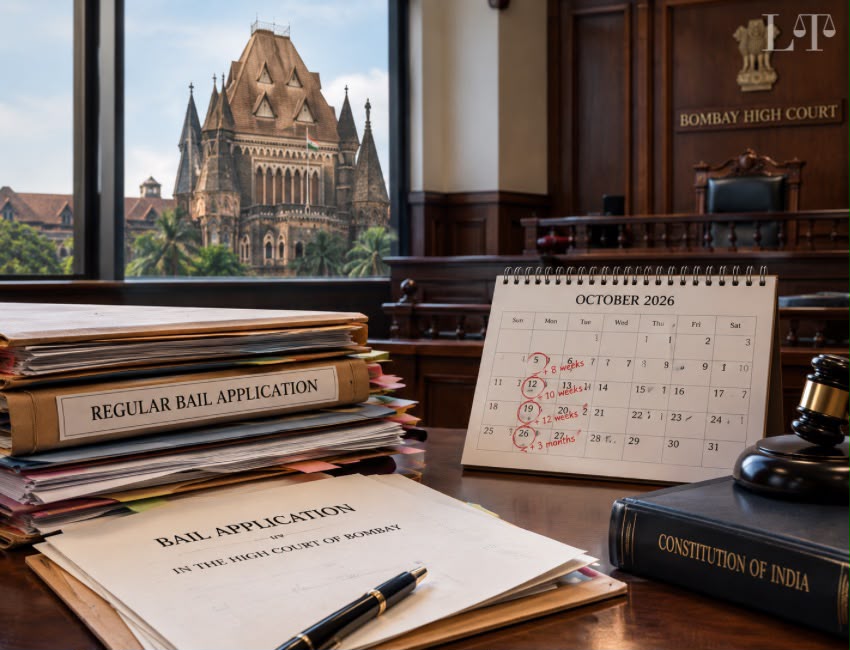
Advocate Shahed Ali Ansari, who practises before the Bombay High Court, has sent letters to the Chief Justice of India and the Chief Justice of the Bombay High Court. He has raised concerns about delays in listing and hearing regular bail applications in the Bombay High Court before the bench of Justice Shyam C Chandak.
The letters are dated October 13, 2026. They say that long listing delays affect the fundamental right to life and personal liberty under Article 21 of the Constitution of India.
In his representations, Advocate Ansari refers to the Supreme Court’s directions on deciding bail applications on time in Satender Kumar Antil v. Central Bureau of Investigation, (2022) 10 SCC 51. He also refers to the observations in Hussain v. Union of India, (2017) 5 SCC 702.
He points out that when bail applications are not listed quickly, undertrial prisoners may have to wait a long time before their applications are heard.
Examples of Delayed Listing:
The letters give specific cases to show the problem.
The first is Bail Application No. 3679 of 2026, Salman Munna Khan @ Dresswala v. State of Maharashtra. This regular bail application was filed and registered on September 9, 2026.
According to the letters, it had not been listed for hearing. A circulation date of November 2, 2026 was given only after a praecipe was submitted. The letter says this means a wait of about 54 days from the date of filing.
The second is Bail Application No. 3580 of 2026, Irfan Mohammed Yasin Shaikh v. State of Maharashtra. It was filed on September 1, 2026 and registered on September 2, 2026. The letter says the matter was listed only once, but it could not be reached because the daily cause list is very long, reportedly with 120 to 150 cases.
The third is Criminal Writ Petition No. 3532 of 2026, Salman Mustaq Ali Khan and Others v. State of Maharashtra and Another, which is about quashing proceedings. The letter says this petition was filed in July 2026 and has stayed pending without an effective hearing.
The letter also mentions, “It is respectfully clarified that this representation casts no aspersion on any Hon’ble Judge. The Hon’ble Judges are working under an immense burden, with daily cause lists often exceeding 120 to 150 matters. The difficulty, it is submitted, is administrative and structural, arising from the allocation of roster and distribution of bail matters, and not from any individual.”
It goes on to say,“It is specifically stated that on 7th October once again I have tried to mention the cases of Bail listed above, I saw a very long Queue of 50 to 60 Advocates as usual who were waiting with their Circulation Praecipe in their hands, to craving for listing of the cases, However, Hon’ble Justice SHYAM CHANDAK never allowed Mentioning even in grave urgency to any one, and warned of adverse orders if anyone mentions their cases, & directed all advocates to just hand over praecipe to the Staff so that 8 weeks time will be given to all. For above Bail Applications already 2 November date is given in Salman Munna khan @ Dresswala Vs State of Maharashtra (REGULAR BAIL APPLICATION NO. 3679 OF 2026).”
Article 21 and the Supreme Court’s Directions
The representation mentions the Satender Kumar Antil case. In that case, the Supreme Court said that bail applications should usually be decided within two weeks, unless the judgment gives a special reason for more time.
The letters also cite the Hussain v. Union of India case to show that bail applications need to be looked at quickly.
They say that when bail applications are not listed for a long time, it raises worries about people getting justice and about their personal liberty under Article 21.
They also explain the problems an accused person may face if they want to take back their pending bail application in the High Court and go to the Sessions Court instead. This can be harder if a chargesheet has been filed in the meantime.
Administrative Steps Requested:
The letters make clear that the problem is about how the court is run and organised. It is about how work is given to judges and how bail cases are shared among them. It is not a complaint against any one judge.
To solve the problem, Advocate Ansari has asked the Chief Justices to consider three steps.
First, dedicated bail benches. He suggests setting up three to four single judge benches to deal only with regular and anticipatory bail applications. As far as possible, these benches should not have other civil or miscellaneous criminal work.
Second, redistribution of the roster. Criminal bail matters should be shared more evenly among judges, so that no single bench carries too much work.
Third, time bound listing. An automated system should be introduced so that every regular bail application is listed within 48 to 72 hours of registration. Disposal of the application should happen within the time limits mentioned in Satender Kumar Antil.
The letters ask for proper administrative orders so that bail applications are listed and heard without too much delay. The issue is about getting a hearing on time. The facts and result of each bail application are for the Court to decide.
The document also mentions that copies of the letters sent to the Chief Justice of India and the Chief Justice of the Bombay High Court are attached.
Copy of the letter sent to Chief Justice of India
Copy of the letter sent to Chief Justice of Bombay High Court