
 By
By 
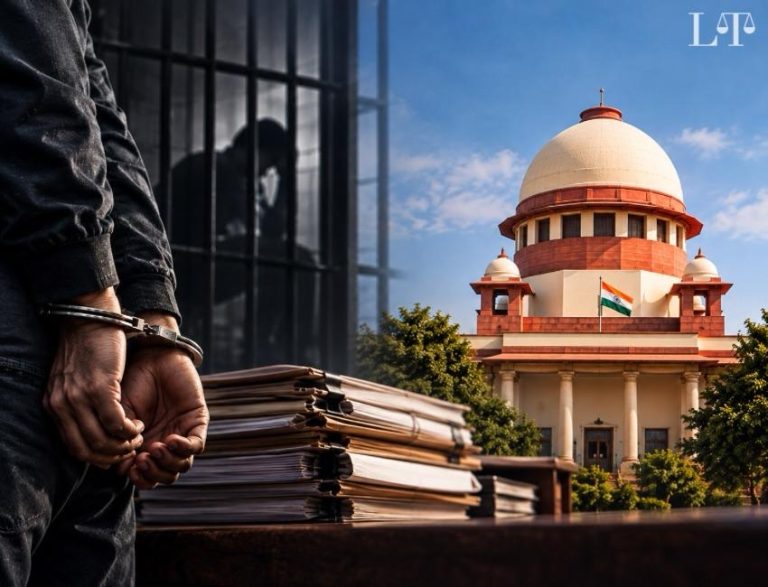
The Bombay High Court held that informing a jailed accused about a request to extend the 180 day investigation period under the Narcotic Drugs and Psychotropic Substances (NDPS) Act, and letting them file a written reply, is not the same as bringing them before the court.
The jail officer, called the Jail Superintendent, passed on the information to the accused.
A single judge bench of Justice Milind Jadhav, in its October 5 order, granted statutory bail to eight men. They were booked in a case involving the recovery of over 1.837 kilograms of mephedrone.
The Court said the accused must be produced before the court, either in person or by video conferencing, when the application for extra investigation time is considered. This is a necessary safeguard.
Background:
The case involved the seizure of over 1.837 kilograms of mephedrone. On July 29, 2024, the Narcotics Control Bureau (NCB) applied to extend the 180 day deadline for completing its investigation. On August 13, 2024, the Public Prosecutor submitted the report that the NDPS law requires. On August 14, 2024, the Special Court allowed the extension.
On July 31, 2024, the Special Court sent a letter to the Jail Superintendent of Yerawada Central Prison. The letter directed that the accused be told about the Investigating Officer’s application and be given copies so they could file a reply. The accused allegedly refused to accept the copies.
The chargesheet was finally filed on February 5, 2025. The accused asked for default bail. Their argument was that they were not produced before the Sessions Court, either in person or by video conferencing, when the extension application was considered and decided.
Extension Is Not a Matter of Right:
Justice Jadhav explained that the prosecution has no right to extra investigation time beyond 180 days. The Special Court can extend the period only if it is satisfied by the Public Prosecutor’s report.
That report must show how the investigation is progressing and give specific reasons for keeping the accused in custody beyond 180 days.
Justice Jadhav said an extension order directly affects the personal liberty of the accused, so the legal requirements must be followed strictly:
“The order of extension therefore is not a mere administrative continuation of the original period. It is an order which directly affects the personal liberty of the accused and permits the prosecution to continue the investigation and detention of the accused beyond the period fixed by the legislature. The statutory requirements governing such extension must therefore be strictly complied with. In the present case the filing of the Application for extension before expiry of the initial period of 180 days is not by itself sufficient to answer the question which arises for consideration,”
Accused Must Be Produced:
On the need to produce the accused, Justice Jadhav said the August 14, 2024 order, as shown to the High Court, did not record that the applicants were produced before the Trial Court, in person or by video conferencing, when the extension application was considered.
The Court said it is not enough that lawyers appeared for some of the accused, or that some accused gave their say. That alone does not prove the law was followed.
Justice Jadhav held:
“However with regard to the crucial requirement of production of the Applicants the order dated August 14, 2024 as presently placed before this Court does not record that Applicants were produced before the Trial Court either physically or through Video Conferencing when the extension application was considered. The fact that Advocates appeared for some accused persons or that certain accused persons submitted their say cannot by itself establish compliance with the law. A communication addressed to the Jail Superintendent and an opportunity to submit a written reply cannot automatically be equated with production of the accused before the Court. This Court is of the view that production of the accused before the Court at the stage of consideration of the application for extension is a necessary safeguard. The requirement is not an empty formality. The order of extension directly affects the personal liberty of the accused because it permits the prosecution to continue investigation and the accused to remain in custody beyond the period ordinarily prescribed by law. The Court while exercising such power must therefore ensure compliance with the procedure recognised by the Supreme Court,”
Later Chargesheet Is No Cure:
The NCB argued that it filed a chargesheet just before the extended 180 day period ended. The Court did not accept this. It said a chargesheet filed later cannot by itself fix a defect in the very order the prosecution relies on to lengthen the legal time limit.
The judge said:
“The prosecution cannot derive an advantage from an extension order without first demonstrating that the order was validly passed in accordance with the statutory conditions and the binding principles governing such extension,”
Seriousness Cannot Override Bail:
The Court noted that the allegations are serious and that the prosecution’s concerns about the effect on society cannot be ignored.
The judge said that for regular bail under the NDPS Act, things like how much contraband was found and the limits in Section 37 are important. But they cannot be allowed to take away a legal right to bail when the conditions for that right have been met.
Justice Jadhav said he knew the prosecution had relied on how big the alleged offence was and how much contraband was involved. These points may matter a great deal when a regular bail application is heard on its merits. But they cannot decide whether the time limit for completing the investigation was validly extended. He said:
“However the present Applications are not applications for regular bail on merits. Applicants invoke a statutory right to default bail. In a case of default bail the principal consideration is different. The Court is required to determine whether the prosecution has completed the investigation within the period prescribed by law or has obtained a legally valid extension of that period. The seriousness of the offence cannot by itself enlarge the period which the legislature has prescribed for completion of investigation,”
Final Directions:
Justice Jadhav held that the right to statutory bail arises when the prosecution fails to meet the time limit set by law. He also held that the Trial Court’s August 14, 2024 extension could not be used against the applicants. The judge ordered:
“The right to statutory/default bail arises from the failure of the prosecution to comply with the time limit prescribed by law. The seriousness of the allegations cannot be used to cure noncompliance with the procedure governing extension of that period. In view of the observations and findings this Court is satisfied that Applicants have made out a case for grant of statutory/default bail. The extension granted by the Trial Court by order dated August 14, 2024 cannot be relied upon against Applicants for the purpose of defeating their statutory right in view of the failure to establish compliance with the requirement of keeping the concerned accused present before the Court at the stage of consideration of the application for extension,”
The Court allowed the applications and granted statutory/default bail to all eight applicants on a surety of ₹1,00,000 each.
Case Details: Bhimaji Parshuram Sabale vs Union of (Bail Application 5481 of 2024)