
 By
By 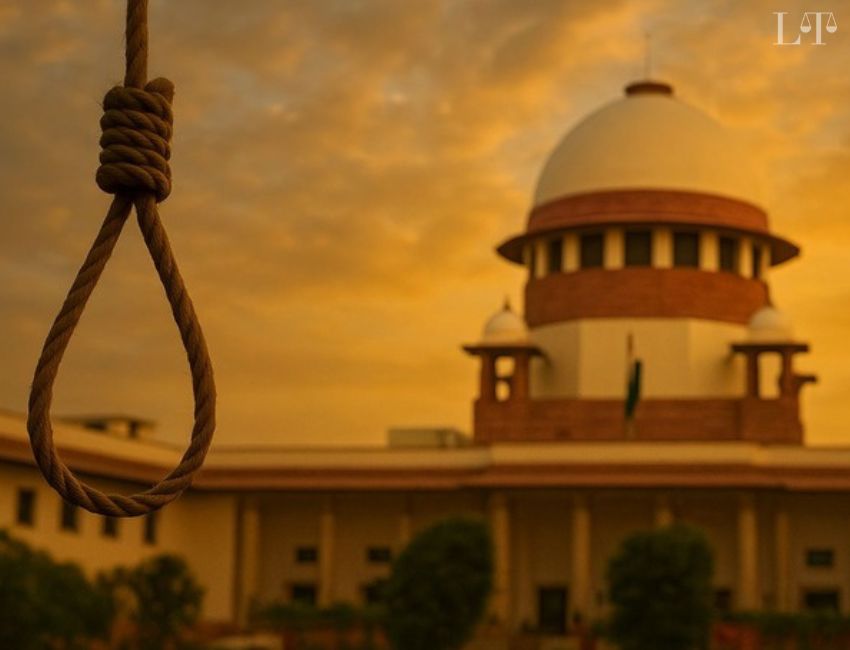
The Supreme Court on Tuesday, refused to strike down hanging as the method used to carry out a death sentence. But it left room for the matter to be looked at again in the future, if strong medical or scientific proof comes up.
A Bench of Justice Vikram Nath and Justice Sandeep Mehta dismissed the petition against Section 354(5) of the Code of Criminal Procedure (CrPC). They made it clear that this ruling does not stop someone from challenging it again in future, and it also does not stop the Union Government from checking on its own whether a better method exists : one that causes less pain and protects the dignity of the prisoner.
What the Petition Asked For
The petition was filed by Advocate Rishi Malhotra. It challenged Section 354(5) of the CrPC, the rule that says a death sentence must be carried out by ordering that the prisoner “be hanged by the neck till he is dead.”
The petitioner argued that hanging causes long physical suffering and goes against the right to dignity guaranteed under Article 21 of the Constitution.
The petition asked for two things:
1. To declare Section 354(5) CrPC unconstitutional, calling it discriminatory, against Article 21, and against the earlier Supreme Court ruling in the Gian Kaur case and
2. To declare that dying through a dignified process is a fundamental right under Article 21.
Why the Petitioner Called Hanging Cruel
The petitioner said hanging was “barbaric, inhuman and cruel.” He asked that it be replaced with methods like intravenous lethal injection, shooting, electrocution, or a gas chamber. He said these methods cause death much faster, and so cause less suffering.
Comparing India’s Rules with International Standards
The petition also pointed to United Nations Economic and Social Council (ECOSOC) resolutions, which say that “where Capital punishment occurs, it shall be carried out so as to inflict minimum possible suffering.”
How Long Does Each Method Take?
The petitioner compared the time taken by different methods. He said hanging, from start to finish, could take more than 40 minutes before death is confirmed. Shooting, he said, takes only a few minutes, and lethal injection ends the process in about five minutes.
The Court’s Earlier Steps on This Issue
The Supreme Court first took up this matter in March 2023. At that time, it considered setting up an expert committee to study the way hanging is currently carried out . The Court asked Attorney General R. Venkataramani to gather details on how hanging affects the body, how much pain is involved, how long it usually takes for death to occur, and what resources are needed to carry it out.
In May 2023, the Attorney General told the Court that the government was thinking about forming an expert committee to look for a better method than hanging. The government later said this matter was being examined at the highest level, and that committees had already been set up to study it.
The Petitioner’s Argument for Choice
During the hearings, the petitioner spoke strongly in favour of lethal injection, pointing out how widely it is used across the United States. He told the Court: “Atleast give an option to the condemned prisoner whether he wants hanging or lethal injection…lethal injection is quick, humane and decent, as opposed to hanging, which is cruel, barbaric and lingering…for 40 minutes, the body lingers on the rope.” He also pointed out that, in certain situations, members of the armed forces are sometimes given a choice in how they die.
The Bench’s Concerns During Hearings
The Bench questioned why the Union Government was against letting death row prisoners choose between hanging and lethal injection. Justice Mehta also raised a separate concern : the psychological toll that carrying out executions can take on the hangmen themselves.
What Project 39A Told the Court
Project 39A also took part in the case and gave its views on other possible execution methods, especially lethal injection.
Project 39A, an initiative of National Law University, Delhi working on criminal justice and legal reform, also assisted the Court during the proceedings and made submissions concerning the viability of alternative execution methods, particularly lethal injection(source: Google).
It pointed to the experience in the United States, where lethal injection is widely used but has also faced serious concerns: about whether it actually works well and how much suffering it causes.
Project 39A suggested that an expert committee should study the available options closely and gather scientific and medical evidence before reaching any conclusion. It also accepted that hanging does involve some pain and suffering, since death is not instant.
The Final Judgment
The case was reserved for judgment in January. The petitioner had relied, among other things, on a Law Commission of India report that compared different methods of execution.
The Supreme Court dismissed this particular petition. But it kept the door open for the issue to be looked at again later, if the situation calls for it. The Court said that if strong medical or scientific evidence comes up in the future showing that a change is needed, that evidence could be used to challenge the current method in court.
The judgment also does not stop the Union Government from carrying out its own detailed review, through an expert body , to check whether another method would work better: one that reduces pain and protects the dignity of the condemned prisoner.
Case Details: Case Title: Rishi Malhotra v. Union of India, W.P.(Crl.) No. 145/2017