
 By
By 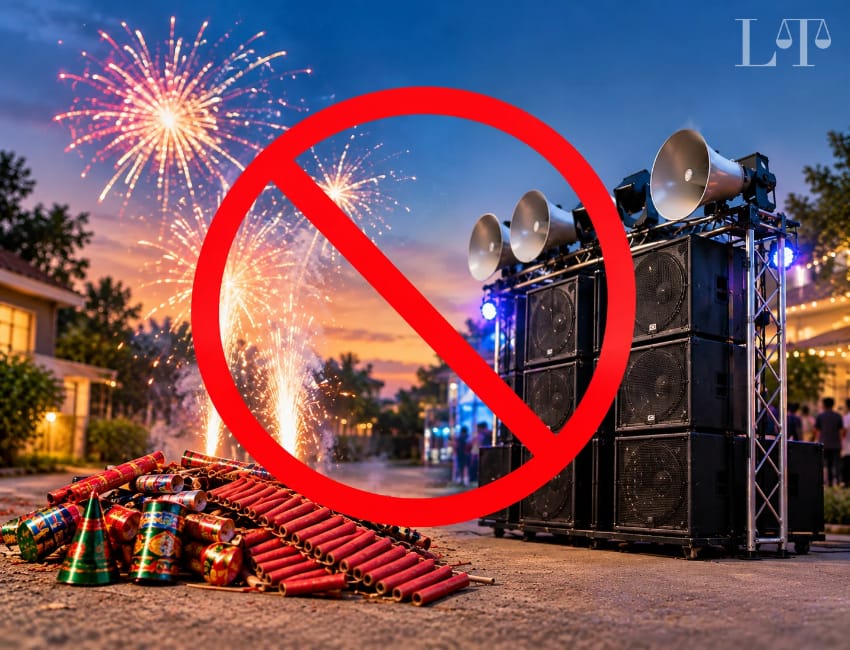
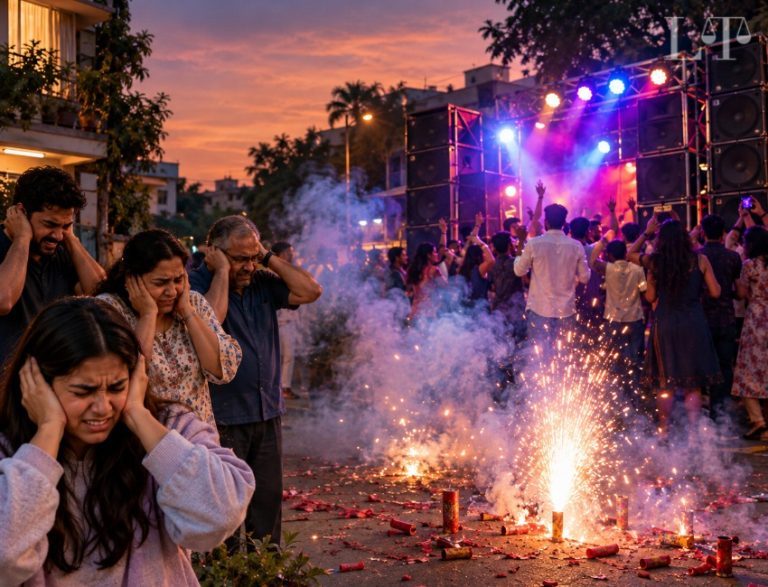
The Bombay High Court on 22 September, 2026 imposed a total ban on bursting of firecrackers on public streets, roads and similar public places during festivities, citing concerns over air and noise pollution. A Division Bench of Justice G. S. Kulkarni and Justice Dr. Neela Gokhale also directed authorities to prohibit the use of laser lights, high-intensity lumen lights and beams during festivals and processions.
Court Examines Existing Noise Rules :
The Court examined the Noise Pollution (Regulation and Control) Rules, 2000, which set limits to control noise pollution. The Court pointed out that loudspeakers and public address systems need written permission before use, and cannot be used between 10 pm and 6 am, except in special cases.
The State Government can allow their use between 10 pm and midnight during cultural, religious, or festive occasions, but only for up to 15 days a year, and only if the Rules’ conditions are followed.
The Court also noted that even when this festive exception is given, the decibel limits still apply. Loudspeakers or public address systems in public places cannot be louder than 10 dB(A) above the normal noise standard, or 75 dB(A), whichever number is lower.
Private sound systems can be only 5 dB(A) louder than the normal noise level allowed at the edge of the property. The Rules also limit loud firecrackers, they cannot be burst in “silence zones” or at night.
The court said: “…sound emitting fire crackers shall not be burst in silence zone or during night time and further that sound emitting constructions equipments shall not be used or operated during night time in residential areas and silence zones.”
The bench looked at how the Rules are enforced. It also looked at earlier court decisions on this topic. Based on this, it said again that the Noise Pollution Rules must be followed. It said that real, effective enforcement is needed to protect people from too much noise and the harm it causes.
Court’s Concern Over Festival Noise:
The Court noted that the complaints it received were about very high noise levels, higher than what is legally allowed. This noise was caused by many loud speakers, musical instruments, banjos, gas cylinders, and other noisy equipment.
The Court said: “The multiple speakers which are operated by use of generators and batteries, is a matter of serious concern.”
The Court also said that anyone using sound systems with written permission must display that permission publicly. The bench then looked at the use of firecrackers during processions.
“We find much substance in the contention of Mr. Chinoy, learned Amicus Curiae that there needs to be an absolute ban on the bursting of fire crackers in such processions where already musical instruments are being used and more particularly, even in the private areas and silent zones,” the court said.
The Court also mentioned Rule 5A(2), which bans loud firecrackers in silence zones or at night. It agreed with concerns about gas cylinders used in processions, which create a lot of noise pollution.
“We also find substance in Mr. Gorwadkar’s contention that there cannot be use of cylinders which generate severe noise pollution in such procession.”
The Court further ruled that any instrument or device that makes noise must stay within the legal noise limits. It said that when rules are broken, such devices and materials must be seized, and proper control is necessary to stop repeated violations.
The bench then talked about how these violations affect ordinary people.
The court said: “We are of the clear opinion that these violations happen as those indulge in the noise violations are least bothered about the rights of the citizens in large and the effect of the noise pollution they create, which are harmful and hazardous to the senior citizens; to those who are ailing/sick; students preparing for examinations and children who cannot sustain the impact of such high level of noise pollution, as observed by us in our earlier order.”
The Court also raised serious concerns about air pollution and accidents caused by firecrackers on public streets.
It said: “We are also seriously concerned with the level of air pollution that would be generated by the bursting of firecrackers on public streets, including other hazardous firecrackers, where pedestrians walk and two-wheelers and cars ply and the dangers of any accidents taking place by abrupt bursting of firecrackers.”
The bench pointed out that firecrackers sold and used openly do not show their noise levels, and there are no rules about how toxic their smoke can be.
The Court said: “The toxicity of pollution being generated by the firecrackers and the cumulative effect it has on the air quality is a serious health hazard, also harmful to every person who is participating in such events.”
Court’s Order:
After considering all these points, the court gave the following orders:
-
Complete ban on firecrackers.
-
Ban on laser lights, very bright lights, and light beams.
-
Noise levels must be measured, and strict action taken against unlicensed sound systems.
-
Devices that break the rules must be seized.
-
A decibel (noise) measuring device is compulsory at every event or procession.
-
Individual and total noise levels must be recorded with officials and organizers present.
-
A deposit should be considered — ₹1 lakh for groups and ₹50,000 for individuals — which will be forfeited if rules are broken.
-
Permissions and organizers’ contact details must be displayed.
-
Organizers must be informed about the rules from the very start of the procession.
-
The combined effect of multiple permissions granted together must be assessed.
-
Citizens should behave responsibly to prevent noise and air pollution.
-
Rule-breakers will face legal punishment under the relevant law.
-
Strict action will be taken for breaking the Noise Pollution (Regulation and Control) Rules, 2000.
-
This order must be sent to all relevant authorities across Maharashtra.
With these directions, the case has been postponed to 15 October, 2026. (H.O.B)
Case details: In Re Noise & Environmental Pollution Public Nuisance against State of Maharashtra