
 By
By 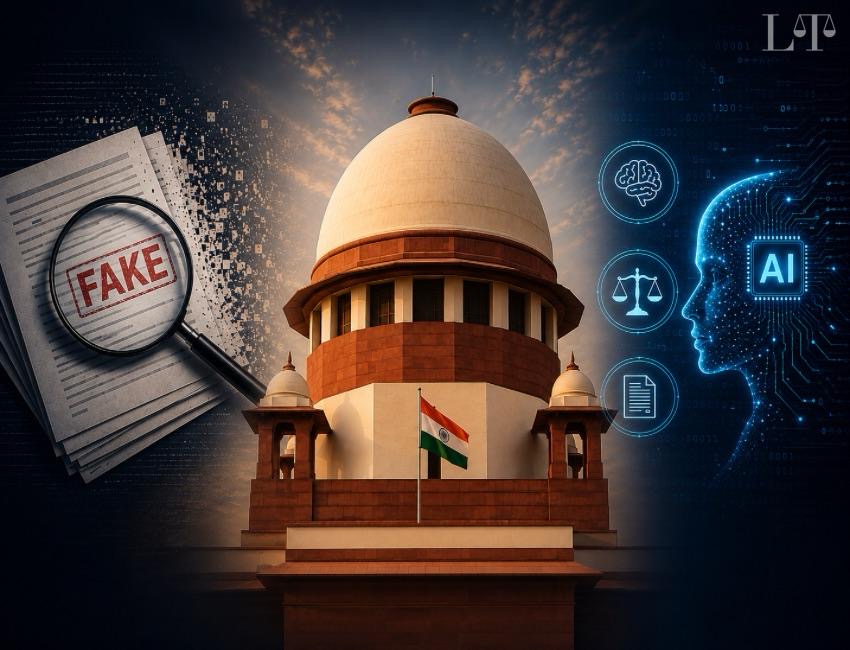
The Supreme Court has cancelled a customs penalty of over ₹425 crore against a diamond trader because the customs officer who issued the fine relied on fake and non-existent court judgments made up by Artificial Intelligence (AI).
A Bench of Justice Dipankar Datta and Justice Sheel Nagu ruled that using fake AI-generated content in legal cases damages the fairness of the justice system..
The judges warned that AI cannot take the place of human decision making. They said:
“Notwithstanding that the regulations are yet to be finalised, use of AI as an assistive tool to speed up the decision-making process cannot be denied. However, a note of caution must be sounded: assistance can never be substituted for adjudication. AI may well serve as training wheels but entrusting it with the pilot’s seat would be both imprudent and dangerous.”
What Happened
The case involves a diamond trader named Vijay Ghanshyam Gadiya.
On October 8, 2025, the Additional Commissioner of Customs in Surat fined Gadiya ₹4,25,27,99,100 under Section 114 of the Customs Act, 1962. The customs department claimed that Gadiya falsely labeled real diamonds as lab grown diamonds to pay lower import taxes.
Gadiya challenged the penalty in the Gujarat High Court, but his appeal was dismissed on January 20, 2026. He then took the matter to the Supreme Court.
Officer Used Fake and “Hallucinated” AI Cases
At the Supreme Court, Gadiya argued that several court rulings and legal articles cited in the customs officer’s order were completely made up using AI tools.
The Supreme Court judges personally checked every judgment and article listed in the officer’s order. They discovered that:
Some of the court cases mentioned in the order did not exist at all.
Other cases had completely fake citation numbers.
A few cases were real, but they did not say what the officer claimed they said.
The Bench described this problem as an “AI hallucination,” a well known issue where AI tools invent false information that looks real.
Explaining what they found, the Bench said:
“Upon verifying such judgments and articles, it does appear that the second respondent has relied upon case laws that are either non-existent or have fake citations. A further investigation has also revealed that some of the case laws relied upon by the second respondent, which do exist, do not lay down the ratio deduced therefrom and it appears to be a hallucination of AI.”
Court Sets a Strict “Zero-Tolerance” Rule
The Supreme Court referred to an earlier ruling, Pooja Ramesh Singh v. Jammu & Kashmir Bank Ltd. (2026), which set a strict ‘zero-tolerance’ policy against using unverified AI created legal cases.
Quoting from paragraph 7 of that decision , the Bench highlighted:
“It is necessary for courts to adopt a zero-tolerance mode for producing, citing or using artificial intelligence-generated precedents without verification. It is a misconduct on the part of an advocate to cite such judgments without verification. Equally, it is a serious lapse if a judge relies on such a fake or hallucinated artificial intelligence-generated material as precedents in support of the determination. We have no hesitation in declaring that such a decision is no decision in the eyes of the law, irrespective of whether such material had a direct or indirect bearing on the decision-making.
Such decisions are to be set aside even if an iota of fake or hallucinated material enters the decision-making process, as it would violate the sanctity of adjudication. It is also clarified that our judgment shall have no bearing on the rightful use of artificial intelligence, but on the presentation or reliance on fake or hallucinated material as if it were a court precedent.”
The Court made it clear that even though it has already prepared draft Regulations for Use of Artificial Intelligence in Courts, 2026, AI is only meant to assist officers and judges, not to make the final decisions for them.
The Case Goes Back for a Fresh Decision
Because the officer relied on fake material, the Supreme Court said that the penalty order could not stand. The lawyer representing the government (the Additional Solicitor General) did not argue against this. He agreed with the Court’s findings.
Explaining why the penalty couldn’t be upheld, the Bench said:
“The use of AI in this case, resulting in reliance placed by the second respondent on material which is dubious, proves fatal to the sustainability of the order imposing penalty on the appellant. Such circumstances compel us to interfere and remand the case. Learned Additional Solicitor General has not joined issue.”
The Supreme Court set aside both the Gujarat High Court’s ruling and the October 2025 customs penalty order.
However, the case is not over. The Supreme Court ordered a fresh review of the diamond trader’s case by a different customs officer of the same rank. The original officer is barred from hearing it.
Finally, the Bench left it to the department’s senior officials to decide whether disciplinary action should be taken against the officer who wrote the order with fake citations:
“We leave it to the wisdom of the appointing authority to initiate such action against the author of the order dated 8th October, 2025, as may be warranted in the circumstances, in accordance with law.”
Case Title: Vijay Ghanshyam Gadiya v. Union of India & Anr.