
 By
By 
The Supreme Court has cleared a former Branch Manager of Indian Bank who had been convicted in a 1991 loan fraud case. The Court said the Central Bureau of Investigation (CBI) could not prove its case and had not even built the case properly. The Court said the case against him was “fabricated and has no legs to stand.”
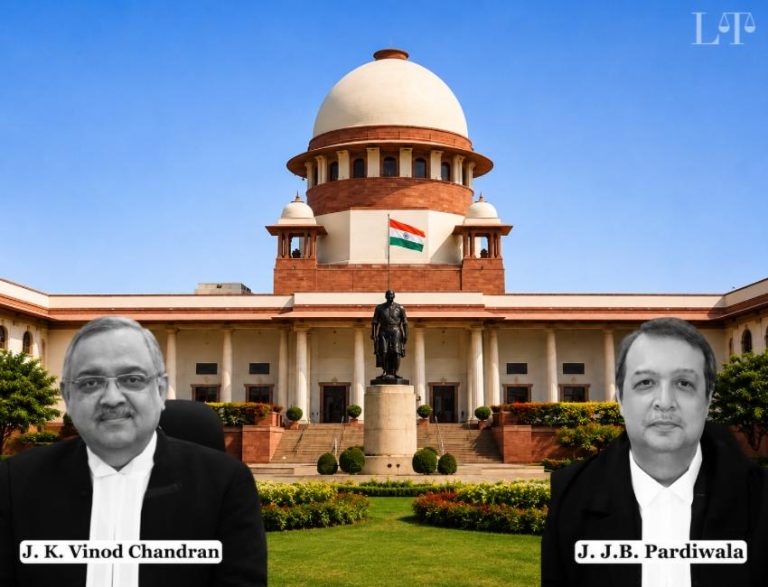
The decision came from a two-judge bench: Justice J. B. Pardiwala and Justice K. Vinod Chandran. They found no reason to keep him convicted. So they cancelled the earlier decisions of both the Trial Court and the High Court, and gave him a full, “clean acquittal.”
What the Case Was About
The case was about loans given out in 1991 and 1992. At that time, the accused person (called A1) was working as the Branch Manager of Indian Bank’s Anna Nagar Branch. The CBI said he worked together with other accused people to give loans to two individuals, A4 and A5. The CBI claimed A4 and A5 were domestic helpers working for another accused person, A2. The CBI also said A2 was the one who actually took and used the loan money.
But the Supreme Court pointed out something important. The loans were actually approved by the Bank’s Regional Office, not by A1 alone. Later, the properties given as security for these loans were sold in an auction. The money from that sale was enough to pay off the loans in full, and a lot of money was even left over after that.
The Loans and the Properties
According to the CBI’s claim, A1 (the Branch Manager) approved these loans along with A2. A4, said to be a washerman working at A2’s house, got a loan of ₹13.5 lakh. A5 got a loan of ₹10 lakh, using 21.39 acres of land as security. The CBI claimed the value of these properties was shown as much higher than it really was, and that A2 took the loan money for himself.
The Court noted that these properties were finally sold at auction only in 2010. This was almost 20 years after the loans were first taken. For A5, one property sold for about ₹1.17 crore, even though only about ₹16.42 lakh was owed on the loan. For A4, the properties sold for about ₹2.42 crore, while only around ₹5.35 lakh was actually used to settle the loan.
No Proof that Properties Were Overpriced
The Court said the CBI never gave any documents from that time, or any official government property rates, to show that the properties were overpriced when the loans were first given. The Court said: “The loan was availed in the year 1991-1992 and the property was auctioned in the year 2010.”
Extra Auction Money Still Sitting Unused
The Court was also surprised that after the loans were paid off using the auction money, a lot of extra money was left over. This extra money was still sitting with the bank, unclaimed.
The bench said: “More intriguing is the fact, as coming out from the testimony of the official witnesses, that the amounts received in auction, in excess of the appropriation to the loan accounts are still remaining with the bank. We are surprised that no attempt was made to find out the legal heirs and pass on the money.”
Court Rejects the Real Estate Angle
The Court did not accept the CBI’s attempt to link A1 to A2’s property dealings. It said: “Real estate business is not an illegal activity and there can be no charge even against A2 on such specious evidence led at the trial.”
The bench looked at all these claims together. These included the claim that A4 and A5 worked as domestic helpers for A2, the claim that A2 took the loan money, the claim that the properties were overpriced, and the claim that A1 broke the rules while approving the loans.
The Court said all of these were “all just figments of imagination.”
Court’s Final Word on the CBI’s Case
The Court put it clearly: “The CBI has failed miserably in not only proving its case but also in framing the case.” It cancelled the conviction and ordered that the accused be released immediately, unless he was needed in some other case.
The bench also clarified: “We make it clear that we have granted a clean acquittal to A1 from the allegations set up by the prosecution.”
What Happens Next
Even though the appeal is now decided, the Supreme Court has asked the Branch Manager of Indian Bank’s Anna Nagar Branch to submit a report about the loan accounts. This report should explain how the loans were settled and how the auction money was used. The Court also asked for the title documents of the mortgaged properties to be produced.
The Court said: “Having found the case to be fully fabricated, we call for a report from the Branch Manager, Indian Bank, Anna Nagar Branch.”
The case is being kept open only for one reason. This is to check what happened to the extra auction money and to make sure it reaches the rightful legal heirs. It will come up again on October 5, 2026. At that time, the Court will look at the bank’s report and decide what to do about the leftover money.
Accordingly, the Appeal was allowed.
Case Details: V. Balakrishnan v. State Rep. by the Deputy Superintendent of Police (Criminal Appeal No.: 2460 of 2026)