
 By
By 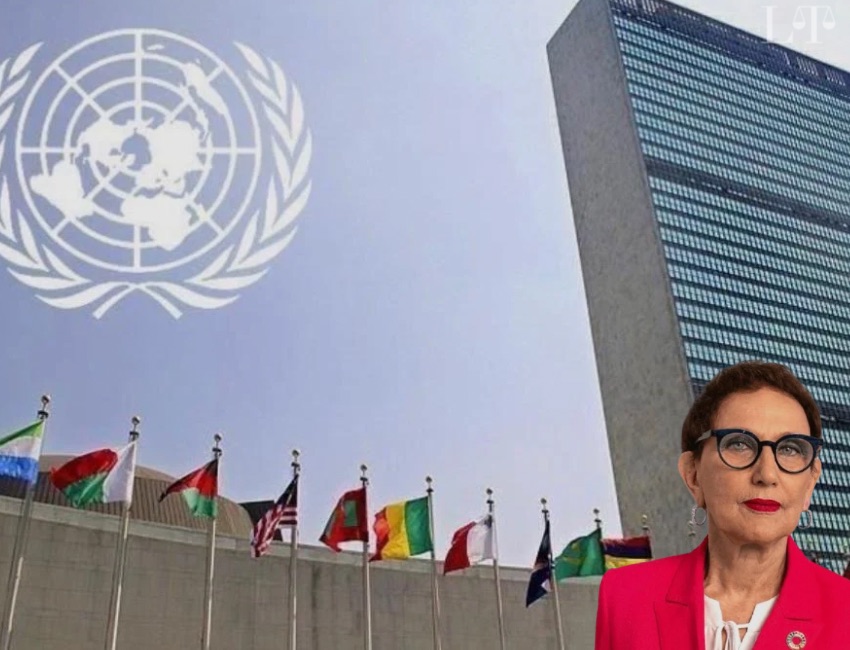
Rebecca Grynspan, a former Vice President of Costa Rica, has emerged as the leading candidate to become the next United Nations Secretary-General. If selected, she would be the first woman and the first Jewish person to hold the position.
Background
Grynspan is an economist who currently serves as Secretary-General of the UN Conference on Trade and Development (UNCTAD), the UN body focused on global trade, investment, finance, and economic development.
In a 2022 podcast interview, she said her Jewish parents fled Poland for the Soviet Union before World War II, as antisemitism and the Nazi threat intensified. Her father escaped with most of his family, while her mother fled with two sisters, leaving her own parents behind , who later died in the Holocaust. After the war, the family settled in Costa Rica.
The Selection Process
In a non-binding straw poll among the UN Security Council’s 15 members, Grynspan received 10 “encourage” votes : ahead of former Guyanese Foreign Minister Carolyn Rodrigues-Birkett, who received 9, and Rafael Grossi, the Argentine head of the UN’s nuclear watchdog, who received 7.
In the United Nations, an “encourage” vote is an informal ballot choice used by members of the UN Security Council during secret “straw polls” to show positive support for a candidate running for Secretary-General. An “encourage” vote signals that a country supports a specific candidate and considers them viable for the top UN job.
In this initial anonymous poll, Security Council members vote for or against each candidate, or register “no opinion.” The next round will show whether one of the Council’s five permanent members – China, France, Russia, the United Kingdom, or the United States – has effectively vetoed a nominee.
Once the Security Council reaches consensus, the nomination goes to the UN General Assembly for formal appointment. Current Secretary-General António Guterres’s second term ends on December 31, 2026, and his successor will take over from there.
Position on the Middle East
Grynspan’s stance on Israel, the Palestinians, and the broader Middle East conflict appears broadly in line with the current UN leadership’s position. In a November 2023 speech following Hamas’s October 7 attack on southern Israel, she condemned the loss of civilian life both in the Hamas attack and in Israel’s subsequent bombardment of Gaza, including strikes affecting civilians, hospitals, shelters, schools, and UN facilities.
Israeli officials have not yet publicly commented on her possible candidacy. The right leaning, pro-Israel NGO ‘UN Watch’ has said her candidacy raises concerns that “the same patterns of bias and politicisation would persist.”
Her Vision for the UN
In her vision statement, titled “A New Vision for the United Nations,” Grynspan wrote:
“To seek the office of Secretary-General is to declare a deep and abiding faith in the United Nations — its principles, its purpose, and its potential. It is to work with tens of thousands of people who give this institution life every day: peacekeepers, field staff, diplomats, experts and policy makers. But across the world, trust in the UN is waning. We owe it to the governments and people we serve to recognise and rise to this crisis of faith. To defend the UN is to have the courage to change it.”
She continued:
“Today the UN confronts a political, a legitimacy and an operational crisis. If elected Secretary-General, my task will be to chart a path of renewal, to make the UN more agile and more accountable to the governments and people it serves. As steward of the Organisation, I can only do this by working with all Member States, in full compliance with the Charter, with humility, integrity and impartiality.”
She states that, if elected, these commitments will guide her three key priorities as Secretary-General.
A Dangerous Moment, An Uncertain Answer
As Grynspan herself has said, “the UN confronts a political, a legitimacy and an operational crisis” . words that carry particular weight at a time when conflicts rage across multiple regions and the world feels more unsettled than it has in decades. Whether she – or any future Secretary-General – can steer the organization through such a grave and turbulent period remains to be seen. With the Security Council still deciding and Guterres’s term ending on December 31, 2026, one question lingers: Can the United Nations rise to meet this dangerous moment in world affairs?
Writer – Rajiv Chavan is a Senior Advocate & Former President of Advocates Association of Western India.