

 By
By 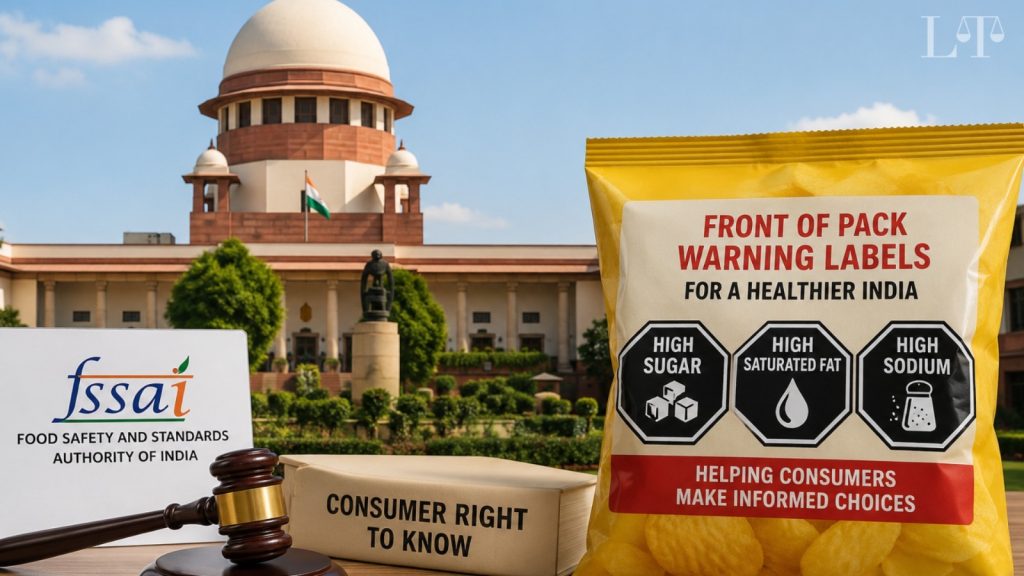
The Supreme Court recently expressed strong displeasure with the Food Safety and Standards Authority of India (FSSAI) for not following the Court’s earlier directions on warning labels for packaged foods.
A Bench of Justice J.B. Pardiwala and Justice K. Vinod Chandran questioned why FSSAI preferred to show the daily recommended limits for sugar, salt and fat instead of giving clear warning labels on the front of packaged food products.
The case:
The case began with a public interest litigation asking for mandatory front-of-package warning labels (FOPL) on packaged food.
In February, the Court was unhappy with FSSAI’s compliance affidavit. It said that the work done by FSSAI had not produced any “positive or good result”.
Earlier direction:
The Court had said that packaged foods should carry easy to understand warnings such as “High Sodium Level”, “High Sugar Level” and “High Saturated Fat Level”. It directed FSSAI to reconsider the issue.
FSSAI’s new plan:
However, in its latest compliance affidavit, FSSAI suggested a different plan. It proposed using pictures to show the daily recommended limits for added sugar, saturated fat and salt. This suggestion was based on the 2024 ICMR-NIN Dietary Guidelines for Indians.
The proposed daily limits were:
1)25 grams of sugar per day
2)10 grams of saturated fat per day
3)5 grams of salt per day
Industry views:
FSSAI also referred to stakeholder consultations held in March 2026. It said that most industry organisations were against “warning labels”. They preferred a system that would help consumers make informed choices “without creating fear amongst the consumers”.
Petitioner’s objection:
The petitioner, represented by Advocate Rajiv Shankar Dvivedi, opposed FSSAI’s proposal. He argued that giving numerical nutrition information was very different from giving a clear warning.
Under FSSAI’s proposed system, a consumer would first have to find the nutrition numbers on the package. Then, the consumer would have to compare them with the recommended daily limits and calculate whether the product had too much sugar, salt or saturated fat.
Need for simple warnings:
The petitioner said this would defeat the main purpose of FOPL. The purpose of such labels is to help people make a quick and informed decision while buying a product.
It was also argued that this system could be especially difficult for people with limited literacy or limited understanding of health information. Pictorial and colour-coded warnings, on the other hand, could show the health risk more clearly and directly.
Question on global standards:
The Court also questioned FSSAI’s argument that international standards on warning labels could not be used in India because Indian dietary habits are different. The Court asked whether Indians should “always remain underdeveloped”.
Concern for children:
The Bench also raised concerns about children’s health. It said: “In our country, how many children can afford dry fruits? And how many of them buy Kurkure? That’s all the difference it makes!”
Industry pressure:
The Court further asked whether FSSAI was ‘bowing down’ to the manufacturing industry. It made clear that its February order was not merely a suggestion. It was a direction that FSSAI had to follow in its true spirit.
Two-week deadline:
The Court said the issue was not just a technical matter about showing nutrition information. It gave FSSAI two weeks to reconsider its current proposal and comply with the Court’s earlier directions.
The Bench also said that if FSSAI did not take proper action, the Court itself could pass an order on the matter.
Case Details: 3S AND OUR HEALTH SOCIETY v UNION OF INDIA AND ANR|15 MA 1177/2025 in W.P.(C) No. 437/2024