
 By
By 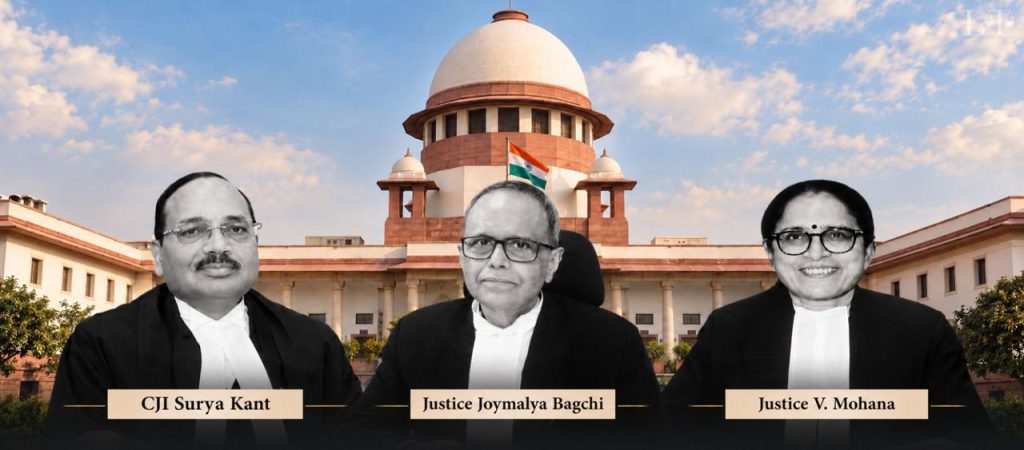
The Supreme Court will examine a big question: does the Bar Council of India (BCI), the body that regulates lawyers, also have the power to control and run law colleges and universities?
A three judge Bench heard the case. It included Chief Justice of India Surya Kant, Justice Joymalya Bagchi, and Justice V. Mohana. During the hearing, the judges asked tough questions about whether BCI is actually qualified to be in charge of legal education.
Background:
The case began with a petition filed by Girish Mittal. He raised concerns about how funds were being used and how the “BCI Trust PEARL-First” was being run. This Trust took over in place of an older BCI Trust that had existed since 1974. Mittal also questioned how two law colleges: one in Goa and one in Andhra Pradesh, were set up through agreements between the Trust and the respective state governments.
Advocate Prashant Bhushan, representing Mittal, told the Court that in 2016, the BCI passed a resolution shutting down its old trust and moving its funds to a new one. He mentioned that the CBI is investigating how this new Trust was formed. Bhushan also claimed that BCI Chairman Manan Kumar Mishra made himself a trustee for life.
He further said that laws passed by the two states gave BCI direct control over these colleges. BCI appoints 27 of the 35 members on the Executive Council, even though the day-to-day running of the colleges is done by the Trust.
He also pointed out that these colleges planned to charge a fee of ₹25,000. Bhushan argued there was a conflict of interest, saying:
“The regulator can’t run this law college.”
Senior Advocate Guru Krishna Kumar, representing the BCI, responded that after earlier court observations on this issue, the BCI had passed a new resolution. Under this resolution, no one can be a trustee for life anymore, a trustee’s term now ends when their BCI membership ends.
The Court Defines the Real Question:
During the hearing, Chief Justice Surya Kant pointed out that even India’s first national law school was originally set up by the BCI. Bhushan replied that this law school is a public university, and its governing body isn’t controlled mainly by the Bar Council.
The Chief Justice then summed up what the case was really about:
“How can BCI regulate law colleges? That’s the real question.”
He explained that BCI’s legal authority only begins after a person becomes a lawyer, so he questioned whether BCI has any right to control a law school or university in the first place:
“Whether law school can be regulated? If that is answered, this is resolved. We’d like to examine whether BCI has power to control and regulate university/law college.”
Is BCI Qualified to Run Legal Education?
The judges observed, during discussion, that academic experts and scholars are in a much better position to handle how education is run than a regulatory body like BCI.
They referred to Section 7(1)(h) of the Advocates Act, 1961. This is the law that gives BCI the job of setting standards and promoting legal education.
Chief Justice Surya Kant said:
“You can lay down the curriculum, whether it should be four years, five years. You can promote legal education and for that, you can take promotional measures. But you can’t control it. What do you know about legal education? There are experts.”
He added:
“How the BCI is expert body to regulate legal education? What do they know about legal education? There are eminent law scholars, academia…you can lay down general guidelines…curriculum should be 4 or 5 year…but you can’t control.”
Senior Advocate Atmaram Nadkarni, appearing for one of the respondents, argued that the Advocates Act does give BCI this power. To support this, he compared it to how the Medical Council of India regulates medical education. He also referred to earlier Constitution Bench judgments about regulators of professional education.
In response, the Chief Justice said the Court would study the relevant laws itself and, if needed, send the matter to a larger bench:
“We would like to examine this and if needed refer it also to larger bench. The very basic issue is how far the Bar Council of India is an expert body to regulate legal education…(Section 7(1)(h)) has been interpreted. We can lay down general guidelines.”
Senior Advocate Shobha Gupta, appearing in a related case, told the Court that the Trust had reportedly received donations worth crores of rupees in exchange for approving colleges, and said this needed to be looked into closely.
Notice Issued:
The Bench has issued a formal notice on the petition, asking the BCI to respond, and asked the petitioner to also send a copy to the Solicitor General’s office.
The Court’s order stated: “Issue notice. Notice accepted by BCI standing counsel. Serve a copy upon the office of SG Mehta as well.”
Case Details: Girish Mittal v. Bar Council of India & Ors. W.P.(C) No. 1115/2026