
 By
By 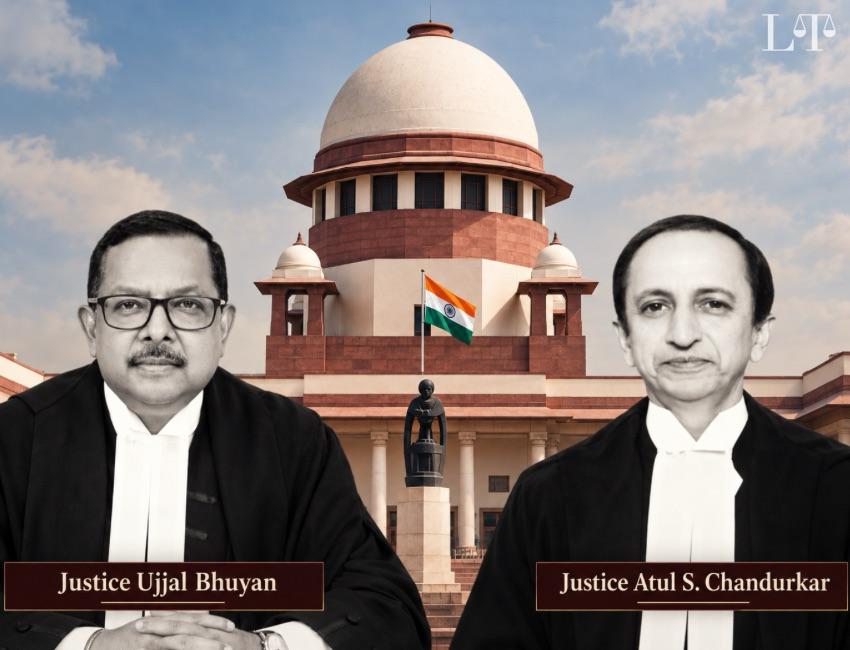
The Supreme Court recently quashed criminal proceedings filed under the Protection of Children from Sexual Offences Act, 2012 (POCSO Act) against a school teacher who was accused of aggravated sexual assault.
Setting aside an order of the Calcutta High Court (Circuit Bench at Jalpaiguri), a bench of Justice Ujjal Bhuyan and Justice Atul S. Chandurkar ruled that resorting to corporal punishment or showing a lack of sensitivity, while wrong, does not count as an offence under Section 10 of the POCSO Act.
Background
The appellant, Bhaskar Paul, taught Geography at Loknathpur High School in Alipurduar. On June 24, 2025, some female teachers told the Headmaster that Paul had physically touched Class X girl students, who had complained about it verbally.
After a meeting was held, the District Child Protection Unit (DCPU) of Alipurduar visited the school on June 30, 2025, and wrote up a Counselling-cum-Enquiry Report.
Based on this report, the Sub Inspector-cum-Officer in Charge of Samuktala Police Station registered a suo motu FIR (No. 187/2025) on July 23, 2025, under Section 10 of the POCSO Act, leading to Special Case No. 83 of 2025 before the Special Court in Alipurduar.
Paul approached the Calcutta High Court under Section 528 of the Bharatiya Nagarik Suraksha Sanhita, 2023 (BNSS) asking for the case to be cancelled, but his request was rejected on April 27, 2026. He then appealed to the Supreme Court.
The Law and the Need for Sexual Intent:
The Court examined Section 10 ( which deals with punishment for aggravated sexual assault) read with Section 9(f) and Section 7 of the POCSO Act. Section 9(f) applies to staff at educational institutions who sexually assault a child, while Section 7 defines sexual assault as touching certain body parts, or making physical contact without penetration, done with sexual intent.
Interpreting these sections, the Court observed:
“From the above, it is seen that whoever with sexual intent touches the specific parts of the anatomy mentioned in the said provision or does any other act with sexual intent, which involves physical contact without penetration, is said to commit sexual assault.”
Corporal Punishment Is Not an Offence Under Section 10:
The Bench examined statements given by the two students to the Magistrate under Section 183 of the BNSS. The students said that the teacher hit them on their back and waist with his hand when they couldn’t answer questions or forgot to bring their Geography maps.
Finding no sexual offence made out, the Court observed:
“While the conduct of the appellant as a teacher may not be appropriate, particularly resorting to corporal punishment and also showing lack of sensitivity while dealing with girl students, however from a careful reading of the statements of the two girl students, certainly it cannot be said that he has committed a sexual offence contemplated under Section 10 of the POCSO Act. When the 02 students were found inattentive in class and did not carry with them their Geography maps which were essential for the Geography class, appellant, as a responsible teacher, could have handled the situation in a much more sensitive manner, but as pointed out above, inadequacy on the part of the appellant or resorting to corporal punishment would not attract Section 10 of the POCSO Act.”
The Lasting Harm False POCSO Accusations Cause Teachers:
The Court spoke about the serious and permanent personal and professional damage such cases cause teachers.
“For a teacher serving in a girls’ school or a school which is co-educational, such an allegation or trial virtually amounts to condemning him, not only for his entire service career as a teacher but for his life as well. He has a family also. Therefore, to accuse a teacher of committing sexual assault on girl students, would be like a death knell for such a teacher. Ultimate acquittal would not redeem the appellant as it would be wholly inadequate to undo all the pervasive damage already suffered by him due to the severity of the criminal trial under the POCSO Act. While the appellant certainly needs to sensitize himself while dealing with students of tender age, particularly girl students, it cannot be a ground for prosecuting him under the stringent provisions of the POCSO Act.”
Case Called a Misuse of the Legal Process:
The Bench also pointed to the delay in lodging the FIR and the fact that the complaints were based on hearsay, saying:
“There are other reasons also for casting aspersions on the prosecution case, particularly the delay in lodging of the first information and the manner in which the Headmaster and the lady teachers had initiated the criminal proceedings against the appellant. After all, their statements are all hearsay evidence.”
The Court ruled that letting the case continue would misuse the legal process and cause serious unfairness to Paul, and it cancelled the High Court’s April 27, 2026 order.
The Court ordered:
“Consequently, we quash the entire proceedings of Special Case No.83 of 2025 arising out Samuktala P.S. Case No.187 of 2025 pending before the Special Court at Alipurduar.”
The appeal was allowed, the appellant was released, and no costs were ordered against either side.
Case details – Bhaskar Paul v. The State of West Bengal, 2026