
 By
By 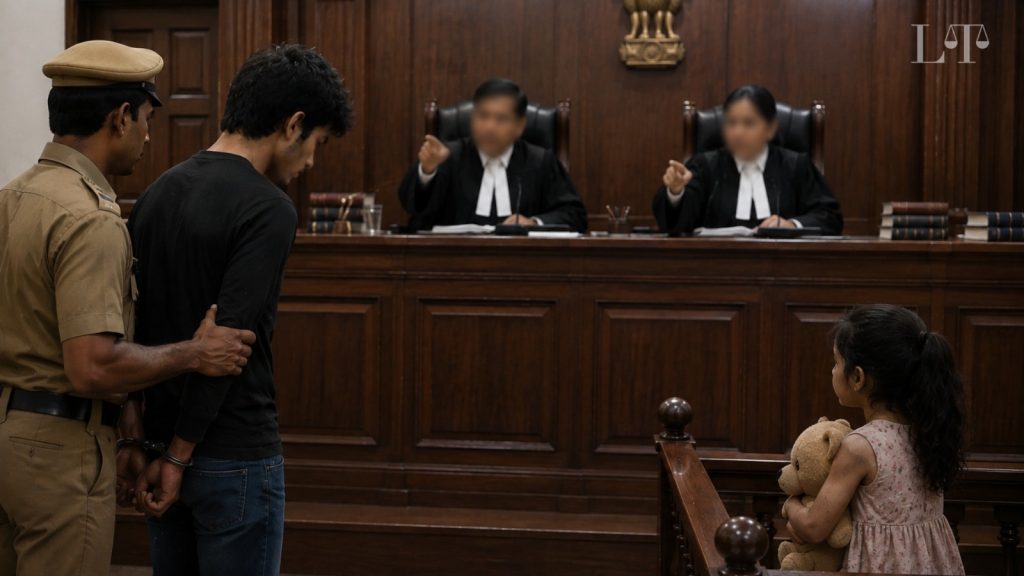
The Bombay High Court recently held that the testimony of a minor victim of sexual assault cannot be rejected only because she cannot describe the sexual act in exact detail.
The Aurangabad Bench of the Bombay High Court, comprising Justice Sandipkumar More & Justice Vaishali Patil Jadhav, overturned the acquittal of Anil Shridhar Gaikwad. He was accused of kidnapping and raping a six-year-old girl in 2012.
Case Background :
The incident took place on May 3, 2012, when the victim was six years old. She was found unconscious under a tamarind tree. Her family members saw blood coming from her private parts.
After she regained consciousness, the child told her parents that the accused, Anil Shridhar Gaikwad, had taken her to that place.
According to the prosecution, the accused first took the child towards a flour mill and then towards a dam. There, he tied her eyes, removed her undergarment, and sexually assaulted her.
On April 19, 2017, the trial court acquitted the accused. It mainly relied on the fact that the child could not clearly explain the sexual act committed against her.
The High Court said that the victim was only six years old at the time of the incident. A child of that age cannot be expected to describe rape as clearly or precisely as an adult witness.
The Court said:
“the victim was a child of tender age of 6 years, and it is not expected from her to describe the act of rape accurately”
Therefore, the Court held that a minor victim’s inability to describe the incident in clear or technical terms cannot be a reason to reject her testimony.
The Bench also noted that the child’s evidence remained consistent. Although she gave her examination-in-chief several years after the incident, she remained consistent about the important facts. She identified the accused and described the incident in the way she understood it as a child.
The Court observed:
“Her cross examination has remained unshaken. Perusal of her examination-in-chief and cross shows that the victim is consistent with the statement even after four and a half years of the incident. This testimony coming from a child cannot be lightly brushed aside. In her evidence, she specifically takes the name of the accused and describes the incident as per her understanding as a child. A child of such tender age cannot be expected to have any motive to falsely implicate the accused.”
The Bombay High Court allowed the State’s appeal and set aside the trial court’s acquittal. It held that the evidence clearly supported the prosecution’s case.
The Court convicted Anil Shridhar Gaikwad for kidnapping and rape.
Because the offence was committed in 2012, the Court applied the law that was in force at that time. It imposed the minimum punishment of seven years’ imprisonment under the then-applicable Section 376 of the IPC, along with a fine.
The accused had already spent about five years in custody. He was directed to surrender before the police and serve the remaining sentence of about two years.
The Court also considered granting compensation to the victim. However, it decided not to do so because she is now married, has two children, and is settled in life. The Bench said that asking her to approach the Court for compensation could force her to revisit the trauma of her childhood and disturb her present life.
Case details: The State of Maharashtra v. Anil Shridhar Gaikwad