Equal Pay Doctrine Gets a Reality Check: Supreme Court Says Experience, Not Just Duty, Counts
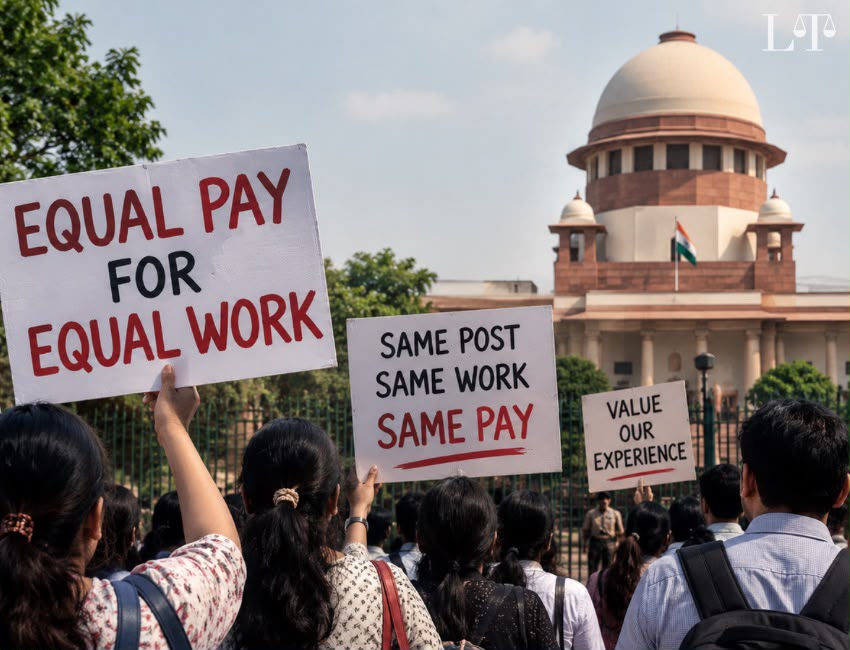
The Supreme Court has held that the principle of ‘equal pay for equal work’ cannot be applied automatically just because two categories of employees do similar jobs.
Factors like how they were recruited, their educational qualifications, their experience, how they were appointed, and the nature of their duties can also matter when deciding if two groups deserve the same pay.
A bench of Justice Dipankar Datta and Justice Sheel Nagu made the observation while dismissing appeals filed by directly recruited Higher Secondary School Teachers, Junior (HSST, Jr.) in Government aided schools in Kerala.
These teachers wanted the same full time pay scale given to HSST, Jr. teachers who got the job through transfer or promotion. They argued both groups belonged to the same cadre and did the exact same work.
Background of the Case:
The appellants were appointed as HSST, Jr. teachers through direct recruitment under a Government Order dated 13 May 1998. They approached the Kerala High Court seeking the full time pay scale given to teachers who joined the same cadre through transfer or promotion.
Both groups belonged to the same cadre and had the same qualifications, duties and responsibilities — yet they were being paid differently. The question before the Supreme Court was whether that was allowed.
A Single Judge of the Kerala High Court had sided with the teachers, based on earlier Supreme Court rulings.
But the Division Bench overturned that ruling. It said promoted teachers couldn’t be treated the same as direct recruits just because they did the same work now. It pointed out that promoted teachers had already worked as full-time, permanent teachers in high schools or lower schools for a long time before moving up to higher secondary schools through promotion.
The Division Bench said the government gave them full-time pay to make sure they didn’t lose their existing status and benefits after being promoted.
It explained that this benefit was really about rewarding the service they’d already put in:
“We therefore feel that the object of the notifications is to protect and retain the benefits and status the promoted teachers were enjoying in the lower schools where from they were promoted. It is essentially a recognition for the service rendered by them and the status they were enjoying as full-time teachers prior to promotion which justify the Government orders authorizing payment of full pay and allowances.”
It also drew a line between the two groups based on prior service:
“Respondents on the other hand are a category of youngsters seeking employment as freshers in the Higher Secondary Schools.”
The directly recruited teachers then challenged this Division Bench ruling in the Supreme Court.
Supreme Court Looks at How the Equal Pay Rule Has Changed Over Time
Before deciding if the two groups deserved equal pay, the Supreme Court reviewed how the “equal pay for equal work” idea has developed in its past rulings.
The appellants relied on older judgments, but the Court noted that the law on this has changed a lot since the case of Randhir Singh v. Union of India.
The judgment explained that earlier rulings focused mainly on whether job titles matched, while newer rulings look at many more factors:
“In the last century, following the decision in Randhir Singh v. Union of India, this Court treated equal pay for equal work as an expansive anti-exploitation principle under Articles 14 and 39(d), where the mere sameness of designation, teacher with teacher, accountant with accountant, clerk with clerk, driver with driver, etc, was sufficient to claim parity. In this century, however, beginning with the decision in State Bank of India vs. M.R. Ganesh Babu and ending with State of Bihar vs. Bihar Secondary Teachers Struggle Committee, the doctrine has been recast as a strict test based on service rules.”
The judgment said it is no longer enough to just show that two employees do the same job. A person claiming equal pay now has to prove full matching across several factors:
“decisions are legion that equal pay cannot be claimed by merely showing identical work; the claimant-employee must establish complete parity in the source of recruitment, educational qualifications and experience, mode of appointment through a constitutional process, and nature of responsibilities and accountability. Mere functional similarity of work has been held to be no longer enough.”
So the question isn’t just about what tasks employees do day to day. How they joined the job, plus their experience and qualifications, matter too.
Different Responsibility Can Justify Different Pay:
The Court then looked at its earlier ruling in State Bank of India v. M.R. Ganesh Babu, which dealt with how hard it can be to decide if people doing similar work should get the same pay.
The Court said you can’t judge work just by how much of it there is. There can be differences in reliability and responsibility even when the tasks look alike.
It quoted the earlier ruling:
“equal pay must depend upon the nature of work done. It cannot be judged by the mere volume of work; there may be qualitative difference as regards reliability and responsibility. Functions may be the same but the responsibilities make a difference.”
The judgment also accepted that sometimes officials have to use their own judgment when deciding pay scales. This is fine and not considered unfair treatment, as long as it is done in good faith, is reasonable, and is based on a clear, sensible reason connected to why the difference is being made.
“So long as such value judgment is made bona fide, reasonably on an intelligible criterion which has a rational nexus with the object of differentiation, such differentiation will not amount to discrimination.”
The judgment also said that things like responsibility, reliability, and confidentiality can matter when deciding whether people in the same post doing similar work can still be paid differently.
Education and How You Were Recruited Also Matter:
The Court also looked at Government of West Bengal v. Tarun Kumar Roy, a case about pay parity between employees who did similar work but differed in other ways.
That ruling made clear that just because the work is the same doesn’t mean equal pay automatically applies. Differences in education or how someone was recruited still count.
The judgment said:
“The said doctrine, however, does not contemplate that only because the nature of the work is same, irrespective of an educational qualification or irrespective of their source of recruitment or other relevant considerations the said doctrine would be automatically applied.”
It also said that having a higher qualification can be a valid reason to treat people differently:
“The holders of a higher educational qualification can be treated as a separate class. Such classification, it is trite, is reasonable. Employees performing the similar job but having different educational qualification can, thus, be treated differently.”
“Equal Pay” Isn’t Just a Math Problem
The Court’s review of these earlier cases showed how hard it can be to say two groups of employees are truly “equal.” Even within the same organization, people who do similar work can still differ in how they got hired and why.
The judgment pointed out that for two groups to be treated as equal, everything about them needs to match up completely, not just some things, but all of it:
“It has been held that this is a concept which requires, for its applicability, complete and wholesale identity between a group of employees claiming identical pay scales and the other group of employees who have already earned such pay scales.”
It also noted that this issue cannot be solved with a simple formula:
“The problem about equal pay cannot be translated into a mathematical formula.”
The judgment then looked at more cases: State of Haryana v. Jasmer Singh, State of Haryana v. Tilak Raj, Orissa University of Agriculture and Technology v. Manoj K. Mohanty, and Tarun K. Roy.
It also said that merit and experience can be valid reasons to pay people differently, as long as there’s a reasonable link between that reason and what the pay difference is trying to achieve.
Don’t Apply the Rule Blindly:
After going through these earlier cases, the Supreme Court summed up the current legal position on equal pay claims.
It said:
“It is, therefore, clear on reading the relevant precedents that a mechanical application of the doctrine of equal pay for equal work has to be eschewed.”
But it also clarified the rule isn’t dead, it can still apply if the facts show real, complete equality:
“It is not the law that the doctrine can never be enforced; but, for such enforcement, a host of factors need consideration.”
Where full equality does exist and the work is truly equal in value, courts can still step in:
“If there is complete parity qua all such factors and should equal pay be claimed for equal work of equal value, the writ court can intervene and grant appropriate relief; otherwise not.”
The Promoted Teachers’ Experience Made a Real Difference:
Applying all this to the case, the Court looked at the difference in teaching experience between the two teacher groups.
The transferred/promoted teachers had already worked as teachers before joining the HSST, Jr. cadre. The direct recruits hadn’t. They joined straight into this role. The Court decided this difference was a good enough reason for the pay gap.
The judgment said:
“Here, the experience of the transferee/promotee HSST, Jr. teachers compared with that of the direct recruit HSST, Jr. teachers provide a valid and intelligible differentia, having a nexus with the object sought to be achieved, to justify grant of a higher pay to the former.”
So even though both groups did the same job in the HSST, Jr. cadre, they couldn’t be treated as equal because their teaching experience wasn’t equal.
Court Rejects the Anirban Ghosh Argument:
The appellants also pointed to a Calcutta High Court ruling, State of West Bengal v. Anirban Ghosh, noting that the Supreme Court had refused to hear an appeal against it on 16 July 2024.
But the Supreme Court found that the Calcutta High Court hadn’t been shown the earlier rulings from the Bihar Secondary Teachers Struggle Committee case.
Because of this, the Court concluded:
“To the extent inconsistent with binding precedents of this Court, the decision in Anirban Ghosh (supra) has to be held per incuriam.”
It also explained that just because it earlier refused to hear an appeal doesn’t mean it agreed with that ruling:
“Also, the mere fact of dismissal of the special leave petition by this Court would not be sufficient for us to take a different view.”
Appeals Rejected
In the end, the Supreme Court decided that the experience of the promoted/transferred teachers and the direct recruits wasn’t equal and that this difference was a fair reason to pay them differently.
The judgment concluded:
“since the two group of teachers cannot claim equivalence qua experience in rendering service as teachers, the same is a valid criterion for differentiation in pay scales.”
Finding no reason to overturn the Kerala High Court’s Division Bench ruling, the Supreme Court dismissed the appeals.


 By
By