
 By
By 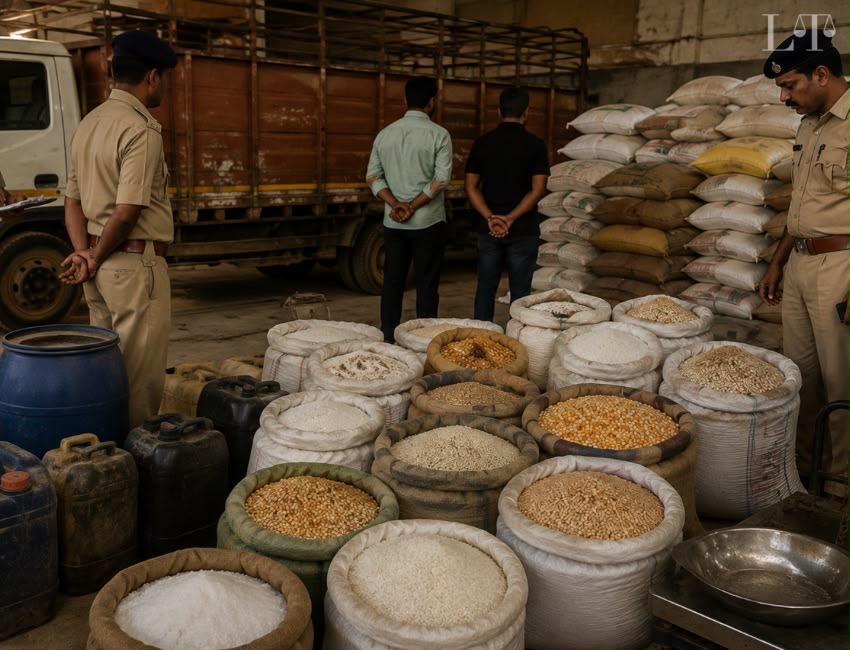
The Aurangabad Bench of the High Court has rejected the interim pleas of two petitioners who sought protection from arrest in two criminal cases registered at Jinsi Police Station, Chhatrapati Sambhajinagar.
The Court held that its constitutional power under Article 226 continues to exist even though the Maharashtra Control of Organised Crime Act, 1999 (MCOCA) bars anticipatory bail. However, the petitioners failed to show the exceptional circumstances required for such pre-arrest protection.
A Single Bench of Justice Hiten Venegavkar was hearing Criminal Writ Petition Nos. 1117 and 1124 of 2026. The petitions sought quashing of Crime Nos. 182 and 181 of 2026 and the proceedings arising from them.
The Court held that the Single Bench had jurisdiction to consider the interim prayers because the matters were criminal writ petitions challenging FIRs. However, it rejected the requests for protection from arrest.
The Two Cases
The two cases arose from searches carried out during the intervening night of June 12 and 13, 2026, at a godown beneath M. R. Function Hall in Rehmaniya Colony, Kiradpura.
Crime No. 181 of 2026 was registered on the complaint of the Assistant District Supply Officer. Authorities allegedly recovered large quantities of wheat, rice, sugar, jowar and maize suspected to have been diverted from the Public Distribution System. Diesel, a weighing scale and an Eicher vehicle were also allegedly recovered.
Crime No. 182 of 2026 was registered on the complaint of the Child Development Project Officer. It concerned take home ration and supplementary nutrition bearing the markings of the Women and Child Development Department. The material was meant for infants, pregnant women and lactating mothers under the Integrated Child Development Services.
The prosecution alleged that this material was obtained without permission, taken out of the distribution system, stored and later sold illegally in the black market.
Petitioners’ Business
The petitioners were not named in either of the original FIRs.
Petitioner No. 1 was stated to be the proprietor of Shree Gajanan Agro Sales Corporation, while Petitioner No. 2 was its manager.
They said the firm was lawfully involved in rice milling, processing and trading agricultural commodities. It was also an empanelled Custom Rice Milling contractor of the State.
The petitioners said that having large quantities of grain, weighing equipment and dealings with transporters were normal parts of their lawful business. They also relied on Government allotments and work orders relating to paddy and Custom Milled Rice.
June Notices
The petitioners mainly relied on notices issued by the investigating agency on June 17 and June 20, 2026.
They argued that these notices showed that the police already knew about Gajanan Agro and the alleged transactions before another search was carried out on July 2, 2026.
July 2 Search
During the July 2 search, the police allegedly recovered a sealed packet of Multi Mix Cereals and Protein Premix bearing Government markings, along with partly burnt or empty wrappers.
Around 1,370 filled bags were also kept for examination by the department.
The petitioners claimed that the bags contained rice bran, rejected rice and other lawful by-products of the milling process.
They alleged that the Government-marked packet and wrappers had been planted. They also raised allegations about the removal of CCTV/DVR/NVR equipment and the conduct of the investigating officers.
They relied on complaints made to senior authorities at the time to show that their allegations of police misconduct were not made later as an afterthought.
Petitioners’ Defence
The petitioners further argued that their names were later mentioned in remand reports as wanted accused, and that they were implicated mainly on the basis of statements made by co-accused while in police custody.
They said there was no independent documentary, electronic or financial material connecting them with the commodities allegedly seized from the original godown.
Senior Counsel for the petitioners argued that the documentary chronology itself suggested a “colourable exercise of powers during investigation”.
It was argued that the earlier notices showed that the investigating agency already knew about Gajanan Agro. Therefore, the later claim in the remand report that the connection was discovered only after a July 2 memorandum was doubtful.
MCOCA Challenge
The petitioners also argued that MCOCA could not be legally applied to them.
They accepted that Section 21(3) of MCOCA bars anticipatory bail. However, Senior Counsel argued that the High Court can still use its constitutional power under Article 226 when the action is allegedly without legal authority, clearly mala fide, or not supported by the law.
State’s Reply
The State opposed the plea.
The learned APP argued that the Court should look at what relief the petitioners were actually seeking, not just what it was called. According to the State, an order preventing the arrest of the petitioners until the quashing petitions were decided would effectively give them anticipatory bail and bypass Section 21(3) of MCOCA.
The State also denied the allegations that material had been planted or that the police had acted improperly.
The State said that the investigating agency knowing about the business earlier did not mean that new incriminating material could not be found during the investigation.
The State further argued that the petitioners’ lawful rice-milling business did not give them permission to possess nutrition packets meant specifically for children, pregnant women and lactating mothers.
Court’s Jurisdiction
The Court also considered the State’s initial objection about its jurisdiction.
The State argued that since MCOCA bars anticipatory bail, a Single Judge exercising Article 226 powers could not grant protection from arrest. According to the State, only a Division Bench could consider such relief.
The Court rejected this argument.
It explained that the roster decides which Bench will hear a case, but it does not take away the High Court’s constitutional powers.
Once a criminal writ petition seeking quashing is properly before the assigned Single Judge, an interim request connected with that petition does not automatically have to be heard by another Bench.
The Bench also made a distinction between the Court’s jurisdiction to hear the matter, whether the request can be legally considered, and whether the petitioners should actually get the relief they are seeking.
It held:
“the question whether the prayer is maintainable before the assigned Bench and the question whether it deserves to be granted are separate.”
The Court made it clear that this did not give a Single Judge the power to hear a regular anticipatory-bail application that is barred by MCOCA.
The Court said it only had to decide whether the exceptional protection under the constitution, sought as part of the quashing petitions, was legally available.
The Bench examined Sections 2(1)(d), 2(1)(e), 2(1)(f), 3 and 23 of MCOCA, including the requirements for continuing unlawful activity, organised crime, organised crime syndicates and prior approval.
The Court noted that Section 21(3) of MCOCA clearly bars anticipatory bail.
However, it held that this statutory bar does not completely take away the High Court’s constitutional power under Article 226.
At the same time, Article 226 cannot be used as another way to get anticipatory bail just because MCOCA does not allow anticipatory bail.
The Bench held:
“Article 226 remains available as a constitutional safety valve, but not as a statutory substitute for anticipatory bail.”
Supreme Court Rulings
The Court relied on the Supreme Court’s judgment in Hema Mishra v. State of Uttar Pradesh. It noted that the Court has constitutional power to grant protection from arrest, but this power must be used only in rare, appropriate and extreme cases.
The Bench also relied on Neeharika Infrastructure Pvt. Ltd. v. State of Maharashtra. It said that investigating cognizable offences is the legal duty of the police. During an ongoing investigation, courts normally should not order “no coercive steps” or “no arrest, especially when the facts are disputed.”
The Court also referred to State of Maharashtra v. Pankaj Jagshi Gangar. It observed that writ jurisdiction cannot be used at an interim stage to give a person almost the same protection that a special law has specifically taken away.
FIR And Prior Approval
The petitioners also argued that they were not named in the FIR and raised questions about the prior approval.
The Bench relied on Kavitha Lankesh v. State of Karnataka and noted that prior approval under the organised-crime law is related to the offence. It does not have to name every person whose role is discovered later during the investigation.
The Court also relied on State of Gujarat v. Sandip Omprakash Gupta. It noted that earlier qualifying charge-sheets and the court taking cognizance of them are relevant to show continuing unlawful activity. However, a later incident showing continuation is also required to establish the actual offence of organised crime.
Disputed Facts
The Bench found that the petitioners had raised serious questions about the June notices, the July 2 search, the alleged recovery and the statutory requirements for invoking MCOCA.
However, the Court said that deciding these issues at the interim stage would require it to decide disputed questions of fact.
The Court specifically said that accepting the petitioners’version would mean finding that the recovered packet and wrappers were planted, rejecting the search record and accepting the petitioners’ version about the DVR/NVR dispute.
According to the Bench, such an exercise could not properly be done while deciding an interim writ petition.
Investigation Papers
The Court also considered confidential investigation papers submitted by the State.
Since these papers had not been given to the petitioners, the Court clarified that they could not be treated as proof of disputed facts against them.
The Bench observed:
“Judicial perusal of such material and adversarial proof of its contents are not interchangeable processes.”
The Court said such material could help it decide whether the investigation was genuine and continuing. However, it could not by itself be used to make an adverse factual finding against the petitioners.
No Exceptional Case
The Bench ultimately held that the petitioners had not shown that the use of MCOCA was “demonstrably without jurisdiction” or that the alleged mala fides were proved by admitted or incontrovertible material.
The Court said the issues raised by the petitioners, including the sequence of documents, the legal requirements for applying MCOCA and the fairness of the disputed search, could be examined at the final hearing.
However, these issues did not meet the much higher standard required for constitutional protection from arrest during an ongoing MCOCA investigation.
No Direction To Arrest
The Court importantly clarified that rejecting protection from arrest did not mean that it was directing the police to arrest the petitioners.
It observed:
“refusal by the writ Court to grant pre-arrest immunity is neither a direction to arrest nor judicial approval of a mechanical arrest.”
Final Order
The Court did not quash either criminal case at this stage.
It issued Rule and made it returnable, but rejected the petitioners’ prayers seeking protection from arrest or coercive action in Crime No. 181 of 2026 and Crime No. 182 of 2026.
Both petitions will be listed together for final hearing according to their turn.
The Court clarified that all observations in the order are prima facie and limited to the interim relief. They will not affect the ongoing investigation, proceedings before the Special Court or the final decision in the petitions.
Therefore, the petitioners’ challenge to the FIRs and the use of MCOCA will continue. However they have not been given interim protection from arrest while that challenge is pending.
The petitioners request to stop the police from arresting them or taking coercive action against them in connection with C.R. No. 181 of 2026, pending hearing and final disposal of the petition, was rejected.
Case Details: Sanjay S/O Bhagirathmal Agrawal & Anr vs State of Maharashtra (Writ Petition (Crl) No. 1124/2026)