
 By
By 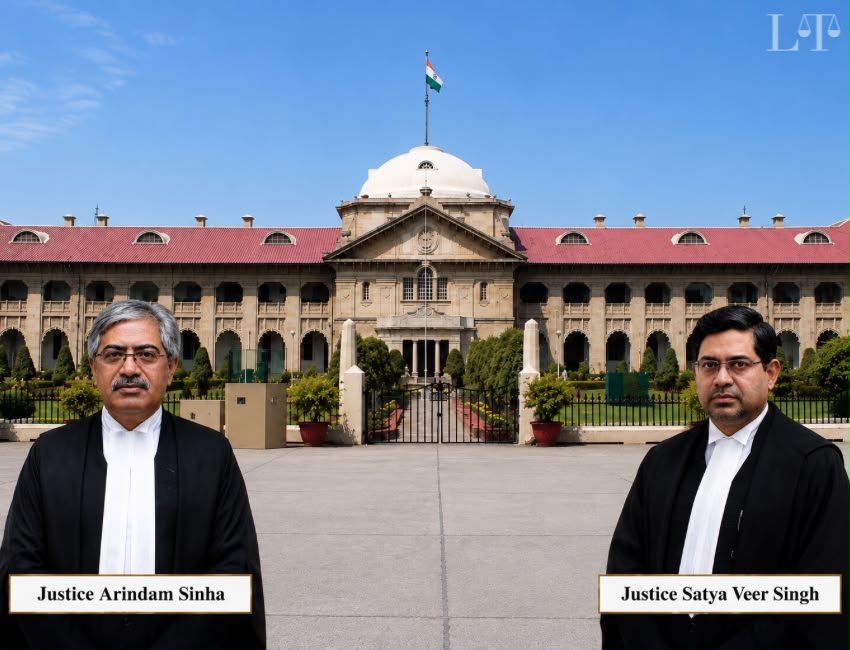
The Allahabad High Court has upheld a Family Court’s decision declaring a woman the legally wedded widow of an Army soldier who was killed in an encounter with terrorists. The Court rejected his parents’ claim that the couple had never married.
A Division Bench of Justice Arindam Sinha and Justice Satya Veer Singh dismissed the appeal filed by the soldier’s parents. The Bench held that the evidence clearly showed that the couple had married on May 12, 2007.
Case Background
The soldier died on January 14, 2008, after suffering a gunshot injury during an encounter with terrorists.
The woman said that she had married him on May 12, 2007, at her parental home in Azamgarh. However, his parents disputed the marriage. They claimed that only an engagement ceremony had taken place on that day and that the actual wedding was fixed for April 24, 2008.
That date never came because their son died before it.
Based on this, the parents argued that the woman could not be treated as his widow and could not claim the benefits available to his widow.
The woman then approached the Family Court and sought a formal declaration that she was legally married to the soldier.
The Family Court framed seven issues, recorded evidence and examined the documents produced by both sides. It ruled in the woman’s favour. The soldier’s parents then challenged that decision before the High Court.
Earlier Admission
The parents’ case was weakened by an earlier petition filed by the soldier’s mother before the Gujarat High Court soon after her son’s death.
In that case, she had clearly admitted that her son had married on May 12, 2007, stating:
“It is not in dispute that the son of the petitioner married on 12th May, 07…”
At that time, the mother did not claim that there had been no marriage. Instead, she argued that the marriage had not been consummated.
She claimed that, according to their custom, the marriage would be consummated only after another religious ceremony, which could take place several years later.
The Gujarat High Court rejected this argument, observing:
“We see no substance in the claim made by the petitioner. Petition is summarily rejected.”
The Allahabad High Court found the mother’s earlier statement important because the existence of the marriage had not been disputed in the Gujarat case.
The Bench held that this earlier admission seriously weakened the parents’ later claim that no marriage had taken place.
Award as His Widow
The dispute continued after the woman received a posthumous award from the President of India on April 19, 2009, at an investiture ceremony at Rashtrapati Bhawan. She received the award as the soldier’s widow.
The soldier’s mother then approached the Gujarat High Court again, this time challenging the woman’s right to receive the benefits after his death.
An earlier inquiry had found that the woman was the soldier’s wife. However, a later inquiry changed that finding and said there was not enough evidence to prove the marriage.
The woman did not appear in those proceedings. The Gujarat High Court ultimately ruled against her and directed that the benefits be given to other relatives instead.
Her review petitions were also dismissed. The Supreme Court later dismissed her special leave petitions on September 1, 2010.
After these proceedings ended, the woman approached the Family Court in Uttar Pradesh to have her marital status formally recognised. The matter eventually reached the Allahabad High Court.
Evidence Supported Marriage
The Allahabad High Court independently examined the Family Court’s findings and found strong evidence supporting the woman’s claim that the marriage took place on May 12, 2007.
The evidence included a wedding invitation card written in the soldier’s father’s handwriting.
The Court also relied on the unchallenged evidence of witnesses who said they had attended the marriage on May 12, 2007.
There was also evidence about a motorcycle gifted to the soldier around the same time. The motorcycle was later registered in the name of a relative connected with the parents’ family.
The parents relied heavily on the fact that there had been no Vidai ceremony. They argued that this showed that no valid marriage had taken place.
The High Court rejected this argument. It agreed with the Family Court that the solemnization of a marriage is different from the Vidai ceremony, which may or may not happen after the marriage.
The Bench observed:
“no positive evidence to show assertion, let alone corroboration that there was only engagement ceremony held on 12th May, 2007.”
2008 Wedding Date Rejected
The parents also claimed that the actual wedding was fixed for April 24, 2008.
The High Court, however, relied on the soldier’s own conduct. He had taken leave from his employer, the Railways, to attend the ceremony in Azamgarh on May 12, 2007.
He had also submitted photographs along with his leave application.
The Bench agreed with the Family Court that the claim about the 2008 wedding date was an “after thought.”
The Court also noted that nothing in the record showed that, during the eight months between the alleged marriage and the soldier’s death, he had ever objected to or disputed the marriage.
Family Court Had Jurisdiction
The parents also argued that the Family Court should not have heard the case because, according to them, the dispute was actually about property and inheritance and not marital status.
They relied on the Supreme Court’s judgment in R. Kasthuri v. M. Kasthuri, where a property dispute between competing claimants was held to be outside the Family Court’s special jurisdiction.
The Allahabad High Court distinguished that case.
It noted that R. Kasthuri did not involve a dispute about whether a marriage existed. That case only concerned who was entitled to the deceased person’s property.
Here, the main question was whether the woman had actually married the deceased soldier.
The Bench said:
“In this case, the controversy is whether respondent had been married to her husband, since deceased.”
The Court held that this difference meant that R. Kasthuri did not prevent the Family Court from hearing the case.
The Bench also noted that a full trial had already taken place, with both sides represented and evidence properly recorded.
Underage Marriage Claim Rejected
The parents finally argued that the woman was below 18 when the marriage took place and that the marriage was therefore void.
An identity card on record showed her date of birth as July 20, 1989. This meant that she was about two months short of 18 when the marriage took place on May 12, 2007.
The High Court noted that the parents had never raised this argument earlier. They had not mentioned it in their written statement before the Family Court and had not asked the Family Court to frame a separate issue on it.
The Bench also rejected the argument on its merits.
It said that merely being underage is not a ground that automatically makes a Hindu marriage void.
The Court further held that, even if such a challenge could be made, it was a matter that could be raised by one of the spouses and not by the parents of either party.
The Court explained:
“The Legislature consciously omitted to include clause (iii) under section 5 in the provision of section 11. Furthermore cause of action in section 11 is only available to a spouse in a marriage. Appellants are parents of the deceased husband. Section 12, providing for voidable marriages, does not mention clause (iii) in section 5, for contravention of which a ground can be urged saying the marriage is voidable and be anulled by a decree of nullity.”
Appeal Dismissed
After examining the pleadings, documents, witness evidence and the earlier litigation, the Allahabad High Court found no reason to interfere with the Family Court’s decision.
The Bench also praised the manner in which the Family Court had conducted the trial, observing:
“We appreciate the manner, in which the Family Court held the trial and confirm impugned judgment.”
The appeal was accordingly dismissed.
Case Title: Rajdhari And Another v. Sadhna Devi