
 By
By 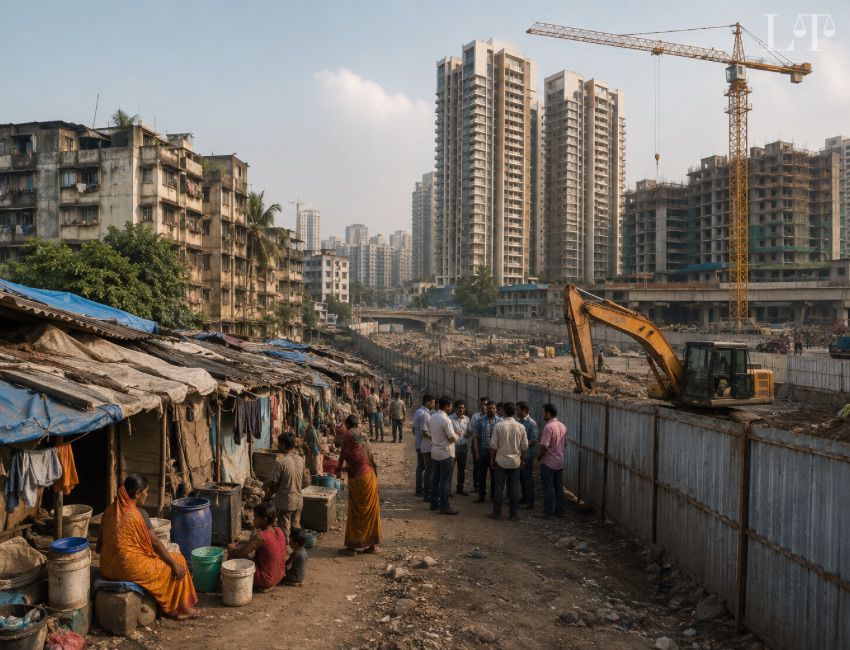
The Bombay High Court has dismissed a writ petition filed by slum dwellers seeking in-situ rehabilitation, or rehabilitation on the same land, at Chinchpokli, Mumbai, which was owned by private developers. The Petitioners had challenged an order dated 13 May 2026 passed by the Assistant Commissioner of the ‘E’ Ward, Mumbai Municipal Corporation, which rejected their appeal against the allotment of permanent alternate accommodation at Bhandup.
The petition was heard by a Division Bench of Justice Suman Shyam & Justice Advait M. Sethna. The Bench refuse to interfere with the order under Article 226 of the Constitution.
The Court found that the order was reasoned and explained the reasons for the decision. It also held that the dispute about where the structures were located and whether the Petitioners were entitled to rehabilitation involved questions of fact, which could not be properly decided in writ jurisdiction.
Case Background
The dispute concerned structures situated on C.S. No. 782 of Mazgaon Division, where the Petitioners claimed to be slum dwellers. Private developers owned adjoining pieces of land, where a redevelopment scheme under Regulation 33(7) of the Development Control and Promotion Regulations for Greater Bombay, 2034 (DCPR) was being carried out.
On 29 March 2007, the Municipal Corporation issued an Intimation of Disapproval to one of the developers. Later, on 4 April 2007, an undertaking was given agreeing to hand over the setback area to the Corporation without any compensation.
Another undertaking, dated 12 March 2008, stated that eligible hutment dwellers living on the developers’ land would be provided accomodation in the proposed redevelopment scheme.
The disputes later led to Long Cause Suit No. 2605 of 2008 before the City Civil Court, Bombay. The Petitioners sought permanent alternate accommodation under the redevelopment scheme. However, the suit was dismissed for non-prosecution in 2013, and their later attempts to restore it were also unsuccessful.
Later, on 12 September 2014, the Corporation issued a communication stating that, out of 44 hutment dwellers, 30 were to be rehabilitated by the Corporation and 11 by the developers. Three structures being used as society offices were to be demolished. An Annexure-II dated 4 September 2015 later declared the Petitioners eligible for rehabilitation under the bottleneck policy.
On 3 February 2026, the Corporation allotted permanent alternate accommodation to the Petitioners at Bhandup. The Petitioners challenged this allotment before the High Court, which directed them to first file an appeal under the bottleneck policy. The Assistant Commissioner then rejected their appeal on 13 May 2026, leading to the present proceedings.
Petitioners’ Arguments
Appearing for the Petitioners, Mr. Singh argued that the undertakings dated 4 April 2007 and 12 March 2008 created a binding obligation on the developers to rehabilitate eligible occupants on the developers’ land.
He also argued that refusing in-situ rehabilitation violated the Petitioners’ constitutional and fundamental rights, including their right under Article 21.
The Petitioners also relied on the case of another hutment dweller, Kishore Amichand Kharva. They claimed that other similarly placed persons had been offered in-situ rehabilitation on the developers’ land and argued that they were therefore entitled to the same treatment.
Respondents’ Stand
Representing the Municipal Corporation, Mr. Chavan said that the Petitioners had already been found eligible for rehabilitation by the Corporation. He said that the Corporation was ready to execute Permanent Alternate Accommodation Agreements and provide them accommodation at Bhandup, where the buildings had already been constructed.
For the developers, Mr. Khandeparkar opposed the petition. He pointed out that the Petitioners had earlier filed a civil suit seeking similar relief. However, that suit had been dismissed and was never restored.
He therefore argued that the Petitioners were effectively seeking a “second bite at the cherry.”
The Bench agreed that there was substance in this argument. It observed that the earlier case and the present petition involved similar and overlapping reliefs.
Court’s Findings
The Bench noted that Annexure-II dated 4 September 2015 clearly showed that the Petitioners were eligible to be rehabilitated by the Municipal Corporation. The Court also noted that this document had never been challenged.
The Court also relied on the Corporation’s communication dated 12 September 2014, which divided the responsibility for rehabilitation between the Corporation and the developers. The Bench observed that the record showed that most of the hutment dwellers, including the Petitioners, were to be rehabilitated by the Corporation.
The Court also held that the impugned order was a “speaking Order,” meaning that it gave detailed reasons for the decision after considering the arguments of both sides. The competent authority had found that most of the Petitioners’ hutments were located on land belonging to the Municipal Corporation and not on the developers’ land.
Rejecting the Petitioners’ claim that the principles of natural justice had been violated, the Bench observed:
“Contextually, we are therefore not persuaded to accept that the Impugned Order is passed in violation of principles of natural justice, as averred in the Petition.”
The Court also held that the Petitioners’ demand for complete rehabilitation records, allotment details, eligibility records, approved plans, agreements and undertakings amounted to a “roving enquiry”, which was not allowed in these proceedings.
The Bench also noted that the Petitioners had not filed a rejoinder to the detailed affidavit-in-reply filed by the developers. The Court recorded:
“We have noted the detailed averments made in the Affidavit-In-Reply filed on behalf of Respondent Nos.4 and 5 to the Petition, which inter alia contain the complete the break-up of the details of rehabilitation by the Respondents in respect of 44 hutment dwellers, including the Petitioners. The Petitioners have not chosen to file a Rejoinder to such Affidavit-In-Reply, though they have proceeded on denial. Be that as it may.”
No Right to In-Situ Rehabilitation
On the Petitioners’ claim that they had a fundamental right to in-situ rehabilitation, the Court relied on Abdul Majid Vakil Ahmad Patvekari & Ors. v. Slum Rehabilitation Authority & Ors. In that case, a coordinate Bench had held that the protection given to protected slum dwellers did not mean that they must necessarily be rehabilitated on the same land.
The Court repeated the principle:
“Mere right of rehabilitation cannot be recognized to be equivalent to a right of ownership.”
Since the Petitioners were not being denied rehabilitation and were instead being offered permanent alternate accommodation at Bhandup, the Bench held that their demand for in-situ rehabilitation on the developers’ land could not be accepted.
The Court also noted that the road adjoining or passing through the developers’ land and the Corporation’s land had been taken over for development by the Road Department in 2014-15. On this issue, the Bench observed:
“Even on this count, the Petitioners’ case for in-situ rehabilitation ‘cuts no ice’ and/or assist the cause canvassed by them in these proceedings.”
The Bench therefore held that it was not persuaded to interfere under Article 226 on the ground that the Petitioners had a right or fundamental right to in-situ rehabilitation on the developers’ land.
Earlier Slum Rehabilitation Cases
Before concluding, the Bench referred to High Court On Its Own Motion v. State of Maharashtra through Government Pleader. In that case, the Court had raised concerns about the implementation of slum laws and the increasing number of disputes under the Maharashtra Slum Areas (Improvement, Clearance and Redevelopment) Act, 1971.
The Court also referred to Yash Developers v. Harihar Krupa Co-operative Housing Society Ltd. & Ors., Moinuddin Pashamiya Shaikh v. Slum Rehabilitation Authority and Bishop John Rodrigues v. State of Maharashtra & Ors.
The Bench noted that these cases contained observations about claims for in-situ rehabilitation. In High Court On Its Own Motion, the Court had observed that such claims “find no justification within our constitutional scheme and is unconscionable.”
Court’s Final Order
The Bombay High Court ultimately refused to entertain the writ petition. It held that the Petitioners could not establish an enforceable constitutional or fundamental right to in-situ rehabilitation on the developers’ land simply because they were protected slum dwellers.
However, the Court did not completely end their legal remedies. In the interest of justice, the Bench allowed the Petitioners to raise their claims and counter-claims before the Appropriate Authority or Court, as permitted by law.
The Court ordered:
“In light of the above, we are not inclined to entertain this Writ Petition. However, in the interest of justice, the Petitioners are at liberty to raise such claims/counter-claims before the Appropriate Authority/Court, as the law would permit.”
The petition was accordingly disposed of, with no order as to costs.
Case Details: Mangesh Yashwant Parave & Ors. Vs State of Maharashtra (Writ Petition (C ) 18278/2026)