
 By
By 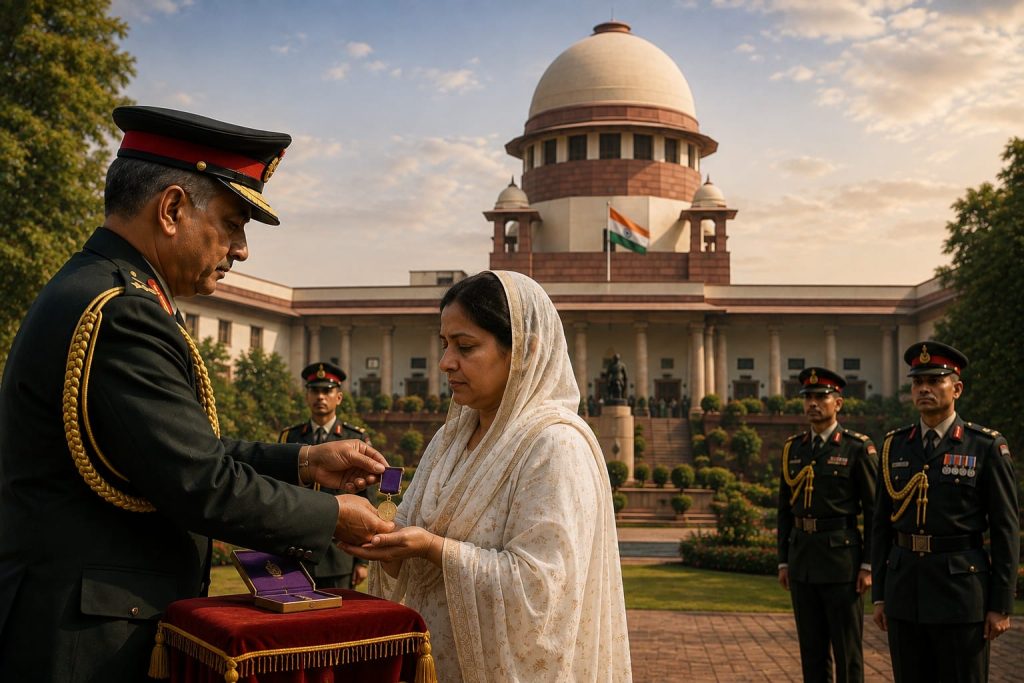
The Supreme Court recently directed the Union of India to pay an additional ₹10 lakh to the widow of a General Reserve Engineer Force (GREF) employee. The employee, Mohan Singh, was posthumously awarded the Shaurya Chakra after he died while saving fellow workers during road construction near the India-China border.
A Bench of Justices K. V. Viswanathan and Arun Palli held that the widow was entitled to extraordinary family pension from the date of her husband’s death. The Court gave this relief even though her lawyer had earlier agreed to limit the arrears to three years.
Case background:
Mohan Singh worked as an Overseer with the GREF. He was posted as In-charge Works for formation cutting of the 57-kilometre Hayliang-Metangliang-Chaglohagom road in Arunachal Pradesh. The road was of major national and strategic importance and was important for managing the Sino-Indian border.
On July 10, 2000, Singh was supervising dozer operations at a dangerous rocky site. He saw a large boulder and debris rolling towards the construction equipment. He immediately helped move the machinery away, protecting both the equipment and the workers.
However, while doing this, he was swept away by the boulder and fell around 70 metres into the valley. In recognition of his bravery, the Government posthumously awarded him the Shaurya Chakra on October 19, 2001.
Pension dispute:
After Singh’s death, his widow, Kuldeep Kaur, received an ordinary family pension. In December 2005, she applied for Special Family Pension under the CCS (Extraordinary Pension) Rules, 1939.
Her claim was rejected because she had received ₹1,84,170 under the Workmen’s Compensation Act, 1923. Her later representation was also rejected.
In 2018, she filed a writ petition before the Punjab and Haryana High Court. The High Court held that her case fell under Category ‘C’ which covers death or disability caused by an accident while performing official duties. It directed her to return the compensation received under the Workmen’s Compensation Act, along with interest at 6% per annum.
She then filed a Letter Patent Appeal. However, the Division Bench limited the arrears to three years before the date on which the writ petition was filed. It relied on an undertaking made on her behalf.
Supreme Court’s reasoning:
The Supreme Court agreed that the widow’s case fell under Category ‘C’. However, it questioned why the arrears had been limited to three years.
The Court said:
“However, considering the fact that the deceased husband of the petitioner made the supreme sacrifice of his life and he was even awarded with the ‘Shaurya Chakra’, we are prima facie of the opinion that the benefit should have been extended from the date of death.”
The Court further observed:
“These are not matters where the family or the widow should be expected to go to Court to obtain relief. The fact that they could go only after a long period of time should in any event not come in the way of rendering justice to them.”
It held that the widow’s delay in approaching the court should not prevent her from receiving justice.
Judgment:
The Bench held that the widow should not lose arrears simply because her lawyer had earlier agreed to limit the claim to three years. Given the special facts of the case, the Court used its powers under Article 142 of the Constitution to grant the benefit from the date of Mohan Singh’s death.
The Court said:
“We have also not confined the relief to a period of three years from the date prior to the filing of the writ petition on account of the peculiar facts of the present case and in exercise of powers under Article 142 of the Constitution of India, we have extended the benefit from the date of the death notwithstanding, the statement of the appellant’s counsel.”
The Court held that a consolidated payment of ₹10 lakh for the period from July 13, 2000 to July 12, 2015 would serve the ends of justice. It directed the Union of India to pay this amount to the widow within four weeks.
Case details: Kuldeep Kaur v. UOI & Ors