
 By
By 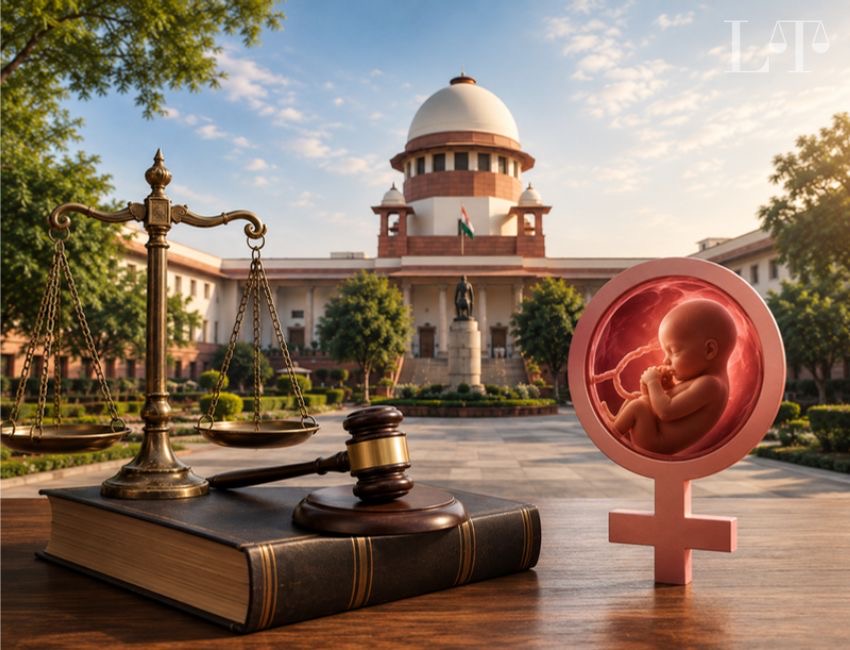
The Supreme Court Bench of Justice Sanjay Karol and Justice N. Kotiswar Singh has clarified how offences under the Pre-Conception and Pre-Natal Diagnostic Techniques (Prohibition of Sex Selection) Act, 1994 (PC & PNDT Act) must be investigated.
The court held that the police cannot be the main investigating authority for offences under the Act. It also held that a Magistrate cannot take cognizance of such offences merely on the basis of a police chargesheet.
Case Background
The case arose from an FIR registered after information was received by the District Magistrate of Bulandshahar about alleged illegal sex determination. A decoy operation was carried out, followed by a raid on the hospital. Thereafter proceedings were initiated against the accused under various provisions of the PCPNDT Act and the Indian Penal Code.
Three Questions
While hearing the matter, the Allahabad High Court noticed that different High Courts had taken different views on whether the police could register FIR’s and investigate offences under the PCPNDT Act.
The High Court therefore referred three questions to the Supreme Court:
- Whether an FIR could be registered merely because the offences were cognizable and non-bailable
- Whether the police could investigate such offences
- Whether a Magistrate could take cognizance on a police chargesheet.
Court’s Observation
The Supreme Court examined Sections 17, 27, 28 and 30 of the Act and Rule 18A of the PC & PNDT Rules.
The Court considered the argument that the word ‘cognizable’ in Section 27 automatically gives the police the power to register an FIR and investigate.
The court rejected this argument. It said that allowing the police to investigate just because the Act uses the word ‘cognizable’ would ignore the Act’s special procedure, which requires medical and technical expertise.
“If the word ‘cognizable’ is taken to mean, as it is generally understood i.e., that the police can, without the permission of the Court concerned, undertake an investigation, it would, in our view, fall foul of the specialized provisions of the special statute,” the court noted.
Police Role
The Bench also examined judgments dealing with similar special laws and the apparent conflict between the general powers of the police and the procedure provided under a special law.
It relied on the principle that when a special law provides a specific procedure, that procedure must be followed. The Court held that the Appropriate Authority (AA) is the only competent authority to investigate offences under the PCPNDT Act. The police can only assist the AA when their help is required.
“Consequently, it can be held that there is discretion in the hands of AA to involve the police as and when it is felt that their assistance is required. The police, when asked to assist, will be required to do so strictly in a supplemental or aiding capacity.” the court observed.
Other Offences
The Court clarified that this restriction does not prevent the police from investigating separate offences under the IPC or BNS. The restriction applies only to offences under the PCPNDT Act.
“For the offences involving other Acts such as the IPC, obviously, there is no restriction on police power in place.” the court noted.
Court’s Answers
The Supreme Court answered the three questions as follows:
1. Police cannot register an FIR under the PC & PNDT Act merely because the offences are cognizable and non-bailable. However, police can investigate independent offences under general criminal law.
“…the requirement of sensitivity along with medical and technical know-how, indicates that the police are not meant to be the investigators for the purpose of this Act.” the court said.
2. The Appropriate Authority is responsible for investigating complaints under the Act, with the police having only a supplementary role when required in accordance with the Act.
“…the police cannot be the main investigating authority. At best, the police may play a supplemental role, as and when required by the AA under its supervision.” the court said.
3. A Magistrate cannot take cognizance of an offence under the PC & PNDT Act on the basis of a chargesheet filed after a police investigation. Cognizance must be taken in accordance with the procedure prescribed under Section 28.
“The competent Magistrate shall not be able to take cognizance upon the filing of a chargesheet.” the court said.
Accordingly, the Supreme Court sent the matter back to the High Court for a decision in accordance with law.
Case details: The State of Uttar Pradesh v. Brij Pal Singh