

 By
By 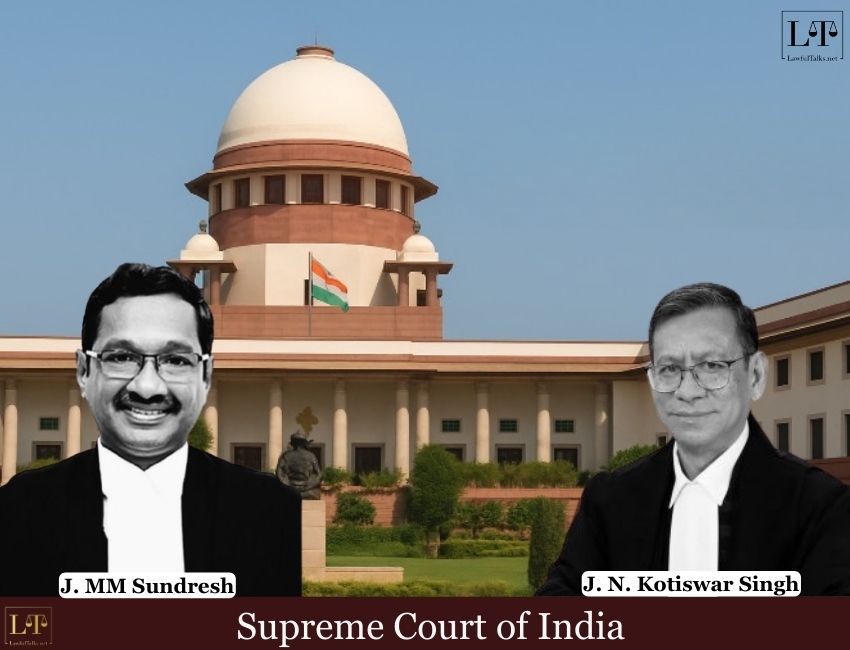
In a landmark ruling, the Supreme Court said that the police must first issue a notice under Section 35(3) of the Bharatiya Nagarik Suraksha Sanhita (BNSS) to a person accused of an offence punishable with up to seven years in prison before making an arrest.
A bench of Justices M.M. Sundresh and N. Kotiswar Singh made it clear that for such offences, an arrest cannot be carried out unless this notice requirement is followed.
When Police Can Arrest Without Warrant:
On the key issue of whether notices under Section 35(3) are mandatory for offences punishable with up to seven years’ imprisonment, the Court explained that arrest is still a matter of police discretion and depends on the facts of each case.
Under Section 35, a police officer can arrest a person without a warrant only if the officer reasonably believes a cognizable offence has been committed and custody is truly necessary — for example, to prevent further offences, help the investigation, protect evidence or witnesses, or make sure the accused appears in court. Both the belief and the need for arrest must meet the requirements of Section 35(1)(b). Even then, the arrest is not automatic.
The Court observed: “…it is amply clear that even if the conditions mentioned under Section 35(1)(b) of the BNSS, 2023 are in existence, there can be no mandatory arrest, as a police officer still may or may not decide to do so.”
The Court also said that police officers must record their reasons in writing whenever they decide to make an arrest.
Section 35(3) provides another option to the police — instead of arresting a person, they can simply issue a notice asking the accused to appear before them. This option is available in all cognizable offences.
However, for offences punishable with up to seven years’ imprisonment, it operates together with Section 35(1)(b) and its proviso, which require the police to give written reasons either for making an arrest or for deciding not to arrest. If the person complies with the notice, they cannot be arrested, as stated in Section 35(5).
Court’s Final Principles Explained
The Court firmly held:
“we have no hesitation to hold that a notice under Section 35(3) of the BNSS, 2023 to an accused or any individual concerned, qua an offence punishable with imprisonment up to 7 years, is the rule, while an arrest under Section 35(6) read with Section 35(1)(b) of the BNSS, 2023, is a clear exception.”
Based on its interpretation, the Court then listed its conclusions as follows:
a. An arrest by a police officer is a mere statutory discretion which facilitates him to conduct proper investigation, in the form of collection of evidence and, therefore, shall not be termed as mandatory.
b. Consequently, the police officer shall ask himself the question as to whether an arrest is a necessity or not, before undertaking the said exercise.
c. For effecting an arrest, qua an offence punishable with imprisonment up to 7 years, the mandate of Section 35(1)(b)(i) of the BNSS, 2023 along with any one of the conditions mentioned in Section 35(1)(b)(ii) of the BNSS, 2023 must be in existence.
d. A notice under Section 35(3) of the BNSS, 2023 to an accused or any individual concerned, qua offences punishable with imprisonment up to 7 years, is the rule.
e. Even if the circumstances warranting an arrest of a person are available in terms of the conditions mentioned under Section 35(1)(b) of the BNSS, 2023, the arrest shall not be undertaken, unless it absolutely warranted
Case Details: SATENDER KUMAR ANTIL VERSUS CENTRAL BUREAU OF INVESTIGATION