
 By
By 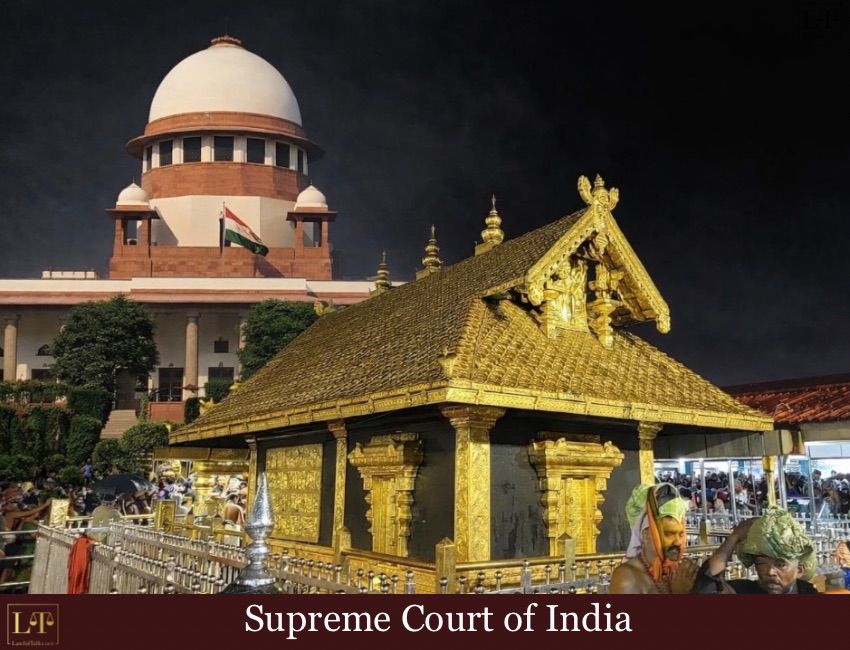
In a significant move continuing his father's fight against superstition, Hamid Dabholkar, the son of slain rationalist Dr. Narendra Dabholkar, has approached the Supreme Court to intervene in the review of the landmark Indian Young Lawyers Association v. State of Kerala judgment.
Along with activist Nandini Jadhav, he has asked the Court to defend the 2018 verdict in the Sabarimala Temple entry case. In that ruling, a 4:1 majority bench led by former CJI Justice D. Y. Chandrachud and others struck down the ban on women aged 10–50 entering the temple. They have urged the Court to dismiss the petitions challenging that judgment.
Details of the Case:
Hamid Dabholkar and Nandini Jadhav are long-time activists associated with the Maharashtra Andhashraddha Nirmoolan Samiti (MANS), founded by Dr. Narendra Dabholkar. Dr. Dabholkar was murdered in Pune in 2013, after which Maharashtra’s Anti-Superstition law was enacted.
In their application before the Supreme Court, they said they are committed to protecting constitutional values such as equality, dignity, fraternity and scientific temper, and have requested the Court to allow them to take part in the case as interveners to assist the proceedings.
The filing says the review petitions do not meet the strict conditions for review under Article 137 of the Constitution. It refers to the case of Kamlesh Verma v. Mayawati and says that the Court can use its review power only to correct clear errors on the face of the record, not to reopen or re-argue issues that have already been settled.
The application also supports the 2018 judgment in Indian Young Lawyers Association v. State of Kerala. It says the bench properly balanced Articles 14, 15, 21 and 25 of the Constitution and correctly held that the ban on women was unconstitutional. It warns that reopening the judgment would weaken the finality of court decisions. The application states that “the judgment under review correctly recognised that menstruation-based exclusion amounts to discrimination on the ground of sex.”
Courts Should Not Decide Religion:
The application also criticises the “essential religious practices” test used in some cases. It says this test makes courts interpret religious texts and beliefs in religions like Hinduism or Islam, which can weaken the secular nature of the Constitution.
It states: “Determining what is “essential” in Hinduism, Islam, Zoroastrianism, or other faiths would position the Court as a theological authority—akin to a Dharmashastri, Alim, or Ulema—interpreting scriptures and faith matters. This contravenes the Constitution’s secular character and the judiciary’s role in a pluralist democracy.”
The application also refers to the warning given by former CJI Justice D. Y. Chandrachud in the original judgment that courts should avoid going too far into religious matters. It says that in a diverse country like India, courts should stay away from deciding theological questions.
Menstruation-Based Ban Is Illegal:
The application says the ban at Sabarimala Temple mainly targets women because of ideas about menstrual “impurity,” which violates Articles 14 and 15 of the Constitution.
It argues that “The exclusion of women aged 10–50 is not an essential religious practice under Articles 25 and 26. Only practices fundamental to the religion qualify for protection. This exclusion, based on the deity’s celibate nature and menstrual impurity notions, reflects socio-cultural constructs, not indispensable Hindu doctrines. No scriptural mandate proves it essential to Lord Ayyappa worship. Even if vratham austerities are central, they are gender-neutral and cannot justify prohibiting women of a specific age group.”
Referring to observations by former CJI Justice D. Y. Chandrachud in the 2018 judgment in Indian Young Lawyers Association v. State of Kerala, the application says the restriction is “manifestly discriminatory” and based on stereotypes without a valid reason.
It quotes the judgment: “The exclusion of women between 10 and 50 years of age is manifestly discriminatory and violative of Articles 14 and 15 of the Constitution. Though framed ostensibly as an age-based restriction, the true basis of classification is menstruation, a biological characteristic unique to women. Such classification is founded upon stereotypes and assumptions of impurity, which cannot constitute an intelligible differentia having a rational nexus with a constitutionally legitimate objective.”
Broader Questions Not Needed:
The interveners have also asked the Supreme Court of India not to examine the broad questions raised in the 2019 reference order in Kantaru Rajeevaru v. Indian Young Lawyers Association. They say these issues were already decided in the 2018 judgment and cannot be reconsidered in a review petition unless there are new facts. They also say the Court should avoid giving advisory opinions.
Plea To Uphold Women’s Entry:
In the end, the application asks the Court to dismiss the review petitions and uphold the right of women of all ages to enter the Sabarimala Temple. It also says the Constitution should be seen as a force for social change.
The plea states: “The Applicants, grounded in rationalism and scientific temper, submits that constitutionally protecting unsubstantiated religious claims threatens Article 51A(h)’s duty to foster scientific temper, humanism, inquiry, and reform. The Preamble’s commitment to fraternity and individual dignity—part of the basic structure—demands rejecting exclusionary practices based on biological impurity, which undermine these core constitutional objectives.”
The application was filed by Advocate-on-Record Anas Tanvir. The Supreme Court will hear the matter before a nine-judge bench starting April 7.