“When 21.95 Kg Isn’t Enough: Delhi HC Says Leaves & Stalks Alone Don’t Make ‘Ganja’’

- April 16, 2026


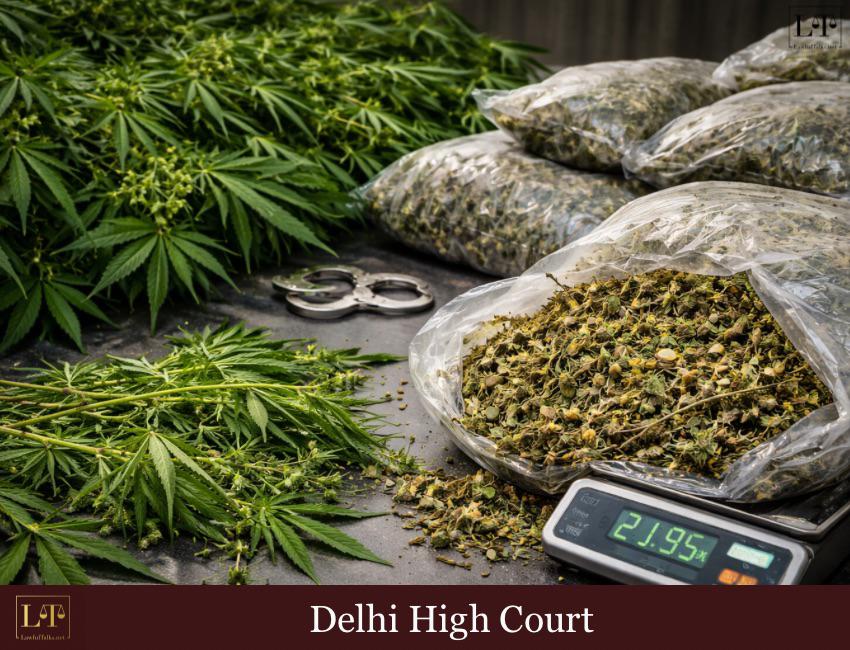
The Delhi High Court granted bail to a person accused in narcotic case, stating that cannabis leaves and stalks cannot be treated as “ganja” when deciding whether the seized substance amounts to a commercial quantity. Because of this, there was uncertainty about whether the strict conditions under Section 37 of the Narcotic Drugs and Psychotropic Substances Act, 1985 (NDPS) Act applied.
Meaning of “Ganja”:
Justice Prateek Jalan explained that under the Narcotic Drugs and Psychotropic Substances Act, 1985,“ganja” has a limited meaning. It includes only the flowering or fruiting tops of the cannabis plant. It clearly does not include seeds and leaves if they are not with these tops.
In this case, the prosecution argued that the total weight of the seized material should be considered to show it was a commercial quantity.
However, the Court noted that the seized material seemed to include leaves, stalks, and other parts of the plant that are not banned. This created doubt about whether the actual contraband met the requirement of commercial quantity.
Court’s Observation
The court said:
“it is evident that the materials seized were not comprised only of “flowering or fruiting tops”, as the Seizure Memo itself refers to ‘dried leaves and small branches’. The weight of the contraband is 21.95 kilograms, which is only marginally in excess of the threshold for commercial quantity of ganja [20 kilograms and above].”
Earlier Case Rule:
The Court relied on Ravina Kumari v. the State (NCT of Delhi) (2024), where it had earlier explained —using a Venn diagram—that when the seized material is a mixed substance containing flowering buds or fruiting tops along with leaves, seeds, and stalks, the extra parts (like stalks and leaves) cannot be treated as part of the narcotic substance.
What Counts:
Only the actual narcotic content, that is the flowering or fruiting tops, should be considered to decide whether the quantity is small or commercial.
Benefit of Doubt:
Because there was uncertainty in the present case, the Court said that at the bail stage, this doubt should be decided in favour of the accused, especially since Section 37 of the NDPS Act has very strict conditions for cases involving commercial quantity.
Trial Needed:
The Court also said that the exact composition and nature of the seized substance can only be properly examined during the trial. So, at this stage, it would not be correct to treat the entire seized material as “ganja.”
Accordingly, the Court held that the strict conditions of Section 37 may not fully apply in this case and granted bail to the accused.
Case Details: Mujabil v. GNCTD (BAIL APPLN. 140/2026)









































































































































































































































































































































































































































































































Sign up for free and be the first to get notified about curated content just for you.